Matteo Scary: A Thoughtful Display Font for Spooky Editorial Moments
Last October, I was redesigning the header for a seasonal newsletter series focused on mindful Halloween traditions—think candlelit recipes, slow-decorating guides, and quiet reflection prompts. The tone wasn’t jump-scare horror; it was atmospheric, nostalgic, gently eerie—the kind of mood you’d find in a vintage drive-in poster or a well-worn library copy of Dark Carnival. That’s when Matteo Scary caught my eye—not as a gimmick, but as a deliberate typographic gesture.
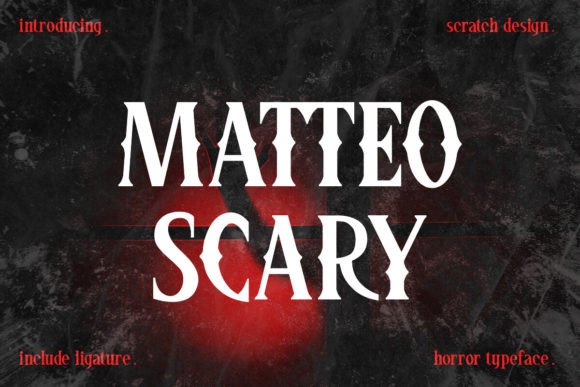
Matteo Scary is a display font rooted in classic horror movie poster aesthetics: uneven stroke contrast, subtle irregularities in letterforms, and a slightly distressed rhythm that feels hand-painted rather than digitally rendered. It doesn’t shout. It leans in. There’s weight to its presence, but also restraint—no excessive serifs or cartoonish spikes. Its personality is grounded in texture and timing: the way the “S” curls like smoke, how the “y” descends with quiet menace, how uppercase letters hold space without overwhelming. It’s not chaotic—it’s composed, with intention.
In practice, I used Matteo Scary for the newsletter’s monthly banner headline—“October Nights: A Slow Guide to Shadows & Sweets”. Set large over a muted charcoal background with generous letter spacing, it anchored the layout without competing with the body text (a warm, highly readable serif). Readers told me it felt “invitingly ominous”—a phrase I hadn’t planned, but one that confirmed the font’s editorial precision. Matteo Scary doesn’t just say “Halloween.” It says, “We’re leaning into this season with care.”
This is where Matteo Scary shines: as a strategic accent, not an all-purpose tool. It’s ideal for blog headers, ebook covers, chapter openers, pull quotes in digital magazines, or title treatments in printable planners—especially those with seasonal or thematic depth. I’ve seen it work beautifully on a coaching workbook’s section divider (“The Unsettling Truths We Avoid”), a recipe ebook’s cover (“Midnight Bakes: Desserts for Darker Hours”), and even a wedding guide’s optional “Eerie Elegance” add-on page—where its gravitas complements calligraphy rather than clashes with it.
It’s not meant for long-form reading. No display font is. Matteo Scary excels in moments of pause—where the reader slows, looks up, and feels the shift in tone. That makes it especially useful in editorial layouts where hierarchy matters: a bold Matteo Scary headline sets the emotional temperature, while a clean sans serif (like Inter or Poppins) carries captions, navigation, and body copy with clarity. For printables, its strong outlines hold up well at 24–36pt sizes—even on textured paper—and export cleanly to PDF without hinting issues.
On screen, Matteo Scary performs best above 28px on desktop and 24px on mobile, with modest tracking (50–80 units) to preserve its breathing room. I tested it across devices and found it legible on iOS Safari and Chrome, though I avoided using it for dynamic web text (like live headlines that resize responsively)—its charm lives in intentional, fixed-size applications.
Font pairing is where Matteo Scary reveals its versatility. With a sturdy serif like Merriweather or Cormorant Garamond, it gains literary weight. With a neutral sans like Lato or Open Sans, it feels contemporary and curated. I once paired it with a delicate script for a printable “Witch’s Journal” cover—Matteo Scary handled the title, the script whispered the subtitle, and a crisp monospace handled the date line. Each voice had its place. No fighting. Just harmony.
Before committing to Matteo Scary in any project, I always check what’s included: does it offer true italics (not skewed), stylistic alternates for the “g” or “a”, or ligatures that enhance flow? Does it support extended Latin characters for international contributors? Is the license clear for commercial use—especially for downloadable templates, client-facing PDFs, or paid newsletters? Matteo Scary comes with a standard OTF/TTF set, basic alternates, and broad language coverage—enough for most indie publishers and creators. But if your project requires Cyrillic or Vietnamese support, verify before finalizing.
What surprised me most was how Matteo Scary deepened consistency—not through repetition, but through resonance. In a six-part digital magazine feature on folklore and modern ritual, we used it only for the main title on each issue’s landing page and the opening pull quote. That tiny, recurring touch became a quiet signature—readers began recognizing the tone before reading a word. It didn’t brand the publication; it *tempered* it. Like lighting, music, or paper stock, Matteo Scary became part of the atmosphere we were building—not decoration, but design intention.
For creators who value mood as much as message—bloggers crafting seasonal content, authors designing their own ebook covers, designers building printable wellness kits—Matteo Scary offers something rare: a premium font that communicates feeling without sacrificing craft. It doesn’t ask to be everywhere. It asks to be *right there*, at the moment the reader leans in.
If you’re choosing a display font for your next editorial project, consider what emotion you want to evoke before you consider what letters you need to set. Matteo Scary won’t solve every typographic challenge—but for those moments when you want your audience to feel the hush before the whisper, it’s quietly unforgettable.