Lonely Night: A Designer’s Real-World Review
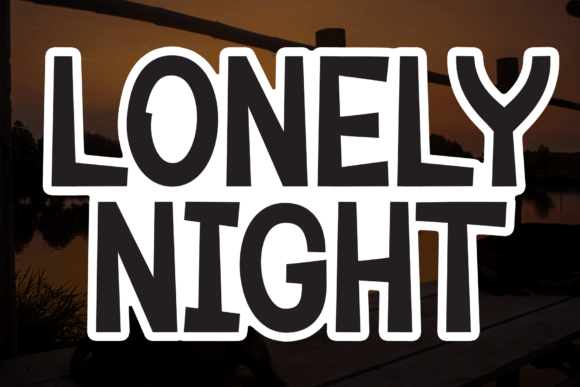
First glance at Lonely Night isn’t just visual—it’s atmospheric. It lands like dusk settling over a quiet city street: moody, deliberate, quietly confident. This is no cheerful display font chasing trends. Its letterforms carry weight—slightly condensed, with subtle flares at terminals, gentle contrast in stroke thickness, and an intentional asymmetry in curves that feels hand-refined, not algorithmically smoothed. It’s neither coldly geometric nor romantically ornate. It’s modern typography with memory—like a serif font that forgot it was supposed to be formal, or a sans serif that remembered how to breathe.
Where It Lives—and Where It Thrives
Lonely Night is a display font, yes—but not the kind you slap on every banner and call it a day. It earns its place where tone matters more than volume: brand marks for indie publishers, boutique skincare lines, vinyl record labels, literary magazines, and small-batch coffee roasters. I’ve used it for a limited-edition poetry chapbook cover—its restrained drama elevated the text without shouting. It worked equally well on matte-black ceramic mugs, where its quiet confidence read as craftsmanship, not clutter.
In logo design, Lonely Night shines when the brand voice leans into nuance: thoughtful, grounded, slightly introspective. It pairs powerfully with minimal iconography—a single line, a negative-space shape, a monochrome mark. Avoid pairing it with loud gradients or busy patterns; it needs room to resonate. For packaging design, especially premium or artisanal goods, it communicates care in execution—not luxury through gloss, but through intention.
Real-World Performance: What Works (and What Doesn’t)
Works brilliantly:
- Short headlines and quotes — especially in editorial design or social media graphics. A pull quote in Lonely Night on a muted background stops scrolling. Not because it’s loud, but because it feels placed.
- Merchandise and printable design — screen-printed tote bags, letterpress wedding invitations, foil-stamped product labels. Its structure holds up under physical reproduction better than many delicate display fonts.
- Digital ads and blog graphics — at 32–60px on retina displays, it reads with clarity and character. It doesn’t vanish on mobile, nor does it overwhelm on desktop.
- Canva templates and Cricut projects — its clean vector outlines scale cleanly, and its spacing remains legible even when resized mid-design.
Use carefully:
- Body copy? No. This is not a serif font or sans serif font built for paragraphs. Even at 18px, readability drops fast—kerning tightens unpredictably, counters close in lowercase ‘e’ and ‘a’, and rhythm stutters.
- Long brand names? Test rigorously. “Mountain & Grove Apothecary” works if shortened to “M&G Apothecary” — but full versions risk visual crowding. Lonely Night favors brevity.
- Supporting text or captions? Resist. Its personality dominates. Let it lead—not explain.
Hierarchy, Trust, and the Unspoken Contract With Your Audience
Audiences don’t read fonts—they feel them before they process words. Lonely Night signals seriousness without stiffness, creativity without chaos. That builds brand consistency and audience trust—especially for creators who sell authenticity as much as product. When a small business owner uses it on their Instagram bio and product label, it tells customers: This wasn’t chosen randomly. This was considered.
But here’s what many miss: Lonely Night doesn’t forgive weak layout. Its mood amplifies imbalance. Center-align it over a chaotic photo? It looks uncertain. Pair it with a clashing script font or overly playful handwritten font, and the hierarchy collapses. It demands thoughtful font pairing. I consistently pair it with a warm, open sans serif font (think Poppins Light or Inter Regular) for body text—or a low-contrast serif font (like Literata or Cormorant Garamond) for editorial depth. Never with another high-contrast display font—that’s visual noise, not harmony.
Designer Notes You’ll Actually Use
Before locking in Lonely Night for client work or your own digital product, do these five things:
- Test it in black and white first. Its strength lies in contrast and form—not color tricks. If it reads with presence in grayscale, you’re on solid ground.
- Check small-size readability — not just at 14px, but at 10px on packaging mockups. Does the lowercase ‘l’ distinguish itself from ‘i’? Does the ampersand hold shape? (Spoiler: it does—but barely at 8pt.)
- Try it on real mockups, not just browser previews. Print a test label. Project it on a wall. See how light hits those terminals. Lonely Night changes subtly under different lighting—softening in ambient glow, sharpening under direct light.
- Compare uppercase vs. lowercase treatment. Uppercase feels authoritative, almost architectural. Lowercase feels more intimate, slightly weathered. Choose deliberately—don’t default to all-caps unless authority is the goal.
- Confirm commercial licensing. Yes, it’s a premium font, and yes, most licenses cover commercial font use—but verify whether your intended use (e.g., embedding in a SaaS dashboard or reselling as part of a Canva template pack) requires an extended license. Don’t assume.
Final Thought: It’s Not for Everyone—And That’s Its Strength
Lonely Night won’t suit a fintech startup demanding urgency or a children’s toy brand radiating joy. It’s not versatile in the way a robust sans serif font is. But versatility isn’t always virtue. In a landscape saturated with safe, scalable, soulless type, Lonely Night offers something rarer: design assets with point of view. Used with discipline—in brand identity, web design, social media graphics, or printable products—it becomes a quiet signature. Not flashy. Not fleeting. Just unmistakably, thoughtfully there.
If your project asks for resonance over reach, mood over momentum, and craft over convenience—Lonely Night isn’t just appropriate. It’s necessary.