Super Crash: A Display Font That Adds Magic to Real Business Branding
Last Tuesday, I was helping a local candle maker update her jar labels—simple white kraft paper, black ink, and a hand-drawn logo she’d loved for years. But something felt off. The label looked friendly, yes—but not quite *distinct*. Not quite *memorable*. She’d tried three different fonts already: one too stiff, one too fussy, one that vanished entirely on small jars. Then we opened Super Crash—and suddenly, the whole project clicked.
What Makes Super Crash Feel Like a Creative Upgrade
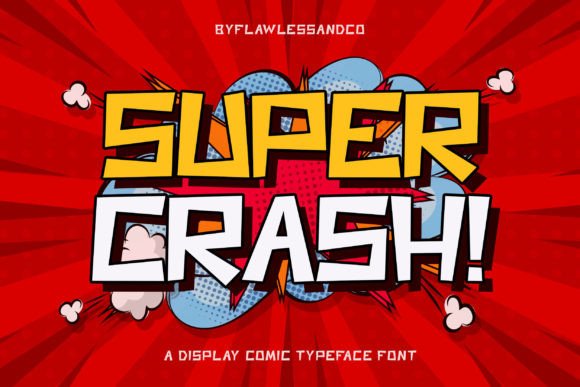
Super Crash is a display font—not meant for paragraphs or fine print, but designed to carry personality in just a few letters. It’s modern without being cold, whimsical without feeling childish, and bold without shouting. Think of it as the kind of typeface that makes people pause mid-scroll on Instagram or tilt their head slightly when they see it on a café menu. Its letterforms have gentle curves, subtle bounce, and a quiet confidence—like a well-crafted greeting card that feels personal but never sloppy.
It’s not a “fun” font in the cartoon sense. There’s no exaggerated wobble or forced playfulness. Instead, Super Crash balances structure and charm: clean proportions with soft terminals, consistent spacing with just enough character to feel human. That balance is why it works so well for real business use—not just mood boards or mockups, but actual product labels, thank-you cards, and shop banners you’ll print and ship.
Where Super Crash Shines in Everyday Business Materials
We tested Super Crash across six common small business touchpoints—and each time, it added polish without overcomplicating things:
- Packaging titles: On a skincare brand’s amber glass bottle, “Glow Mist” in Super Crash (with a light sans serif subtitle) gave instant warmth and clarity—no extra illustrations needed.
- Menu headers: A neighborhood café used it for section dividers (“Pastries,” “Specials,” “Cold Brew”)—clean enough to read at a glance, distinctive enough to reinforce their relaxed-but-considered vibe.
- Social media graphics: For an online pottery shop’s new launch post, Super Crash in all caps against a neutral background made the product name pop—even in tiny Instagram story thumbnails.
- Thank-you cards & stickers: Printed on recycled kraft stock, its slightly rounded shapes softened the rigidity of the paper, making handwritten notes feel more intentional.
- Online shop banners: Paired with a clean sans serif body font, it created visual hierarchy instantly—no designer needed to explain why “New Arrivals” felt more inviting than before.
It’s worth noting: Super Crash isn’t built for long blocks of text. You won’t want it for ingredient lists, care instructions, or website body copy. But as a display font—used for logos, headlines, packaging names, social captions, and decorative accents—it delivers strong, consistent impact.
How It Builds Trust (Yes, Really)
Typography quietly shapes how customers perceive your business. A rushed, generic font can unintentionally signal “I threw this together.” A thoughtful, cohesive choice like Super Crash says, “I paid attention—to detail, to tone, to how my brand feels in someone’s hands or on their screen.”
That matters most where first impressions count: a product on a shelf, a banner above your Etsy shop, or a sticker sealing a package. Super Crash doesn’t scream “look at me!”—it invites attention with warmth and intention. Customers don’t need to know typography terms to feel the difference. They just know something feels *right*.
We also noticed it helped unify materials that previously felt disconnected—a boutique owner had used three different fonts across tags, receipts, and Instagram highlights. Switching all headline treatments to Super Crash (with one supporting sans serif for everything else) made her whole brand feel like it belonged to the same person, not three different designers.
Smart Pairing & Practical Tips for Real Use
Super Crash pairs beautifully with simple, legible companions. Try it with:
- A neutral sans serif (like Inter, Poppins, or Montserrat) for body text, pricing, or fine print—clean contrast that keeps focus on the personality of Super Crash.
- A delicate serif (like Playfair Display or Cormorant Garamond) for elegant contrast—great for wedding stationery or premium skincare lines.
- A restrained script (not overly flourished) for accent phrases like “hand-poured” or “locally made”—just enough texture without competing.
Before using it commercially, double-check what’s included: most Super Crash licenses cover desktop use (labels, cards, PDFs), web use (via @font-face), and even app or digital template licensing—but always verify file formats (OTF/TTF/WOFF), language support (especially if you use accents or non-Latin characters), and whether alternates or ligatures are available. Some versions include stylistic sets that soften edges or add subtle flair—small details that make a big difference on printed packaging.
And a quick readability note: because Super Crash has moderate x-height and open counters, it holds up well even at 14–16pt on small labels or mobile screens—but avoid going smaller than 12pt for physical products. On dark backgrounds, increase letter spacing slightly to maintain clarity.
At the end of the day, Super Crash isn’t about chasing trends. It’s about finding a display font that feels like a natural extension of your voice—whether you’re hand-pouring candles, baking sourdough, curating vintage clothing, or launching your first digital course. It’s the kind of creative font that doesn’t ask you to change your brand—it helps your brand be seen, remembered, and felt, exactly as you intended.