Gionstone: A Spooky Display Font That Brings Halloween Magic to Real Products
It started with a candle label—just one, pinned to my corkboard beside a half-printed batch of black-and-orange soy wax jars. I’d been testing fonts for weeks: too playful, too elegant, too generic. Then I opened Gionstone, typed “Midnight Bramble,” and felt that little jolt—the kind that says, This is the one. Not because it’s flashy or trendy, but because it *breathes* atmosphere. Gionstone is a display font built for mood, not just message—and for makers who craft tangible things, that distinction changes everything.
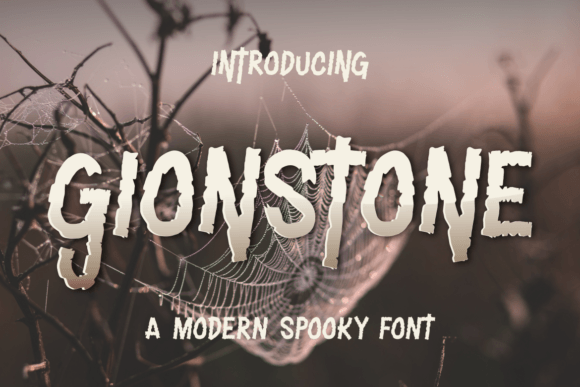
Gionstone leans into its Halloween soul without tipping into cartoonish cliché. Think delicate yet deliberate strokes, subtle tapering, soft serifs that curl like smoke, and letterforms with quiet asymmetry—like ink dried just slightly uneven on aged parchment. It’s not scary; it’s mysterious. Not gaudy; it’s evocative. That balance makes it unusually versatile across handmade formats: a single word on a kraft paper tag, a short phrase on a matte-finish sticker sheet, or an elegant title on a printable planner page designed for October reflection.
I’ve used Gionstone most often for candle labels and greeting cards—but it’s equally at home on boutique tags, digital wall art previews, wedding welcome boards (yes, even for moody autumn nuptials), and seasonal tote bag designs. Because it’s a display font, it shines where impact matters more than length: product names (“Witch’s Brew,” “Cinder & Clove”), event titles (“Harvest Moon Soirée”), shop banners (“October Shop Update”), and decorative headers in printable templates. It doesn’t work well for body text or long paragraphs—that’s not its purpose—and trying to force it there dulls its charm. But as a focal point? It adds instant narrative weight.
When I printed Gionstone on 2” round stickers for mini apothecary jars, I noticed how clearly it cut on my Cricut Maker—especially in the medium weight. The letterforms hold their shape even at 14pt, as long as spacing stays generous and outlines aren’t overly tightened. For small labels or iron-on transfers, I stick to bold or regular weights and avoid ultra-thin alternates unless scaling up past 20pt. On physical merchandise like mugs or shirts, I pair Gionstone with a clean sans serif (think Montserrat or Inter) for care instructions or fine print—letting the display font command attention while the supporting type stays legible and grounded.
That pairing instinct is key. Gionstone sings brightest when contrasted thoughtfully: against a crisp, no-frills sans serif for modern balance; next to a gentle script font for layered invitations; or over a warm, low-contrast serif for vintage-inspired packaging. I once designed a set of printable Halloween planner pages using Gionstone for section headers (“Spells & Schedules,” “Treat Tracker”) and paired it with a soft handwritten font for checkboxes and notes—creating hierarchy without clutter. The result felt intentional, cohesive, and quietly luxurious—not just “Halloween-themed,” but *designed*.
For digital downloads, Gionstone adds polish to listing previews and template thumbnails. When customers scroll Etsy or Creative Market, that distinctive lettering catches the eye before they even read the description. It signals craftsmanship—not because the font is expensive, but because it’s *chosen with purpose*. And yes, it’s a commercial font, so I always double-check the license before bundling it into SVG files, editable Canva templates, or printable kits. The included OTF and TTF files load smoothly in design apps, and I appreciate having both standard and alternate characters—like the swashed “Q” or stylized ampersand—for subtle personalization in shop branding or limited-edition tags.
Readability in mockups matters just as much as in production. When prepping listing images, I test Gionstone at actual print sizes: zoomed-in on a mug mockup, scaled down on a 3×4” card preview, cropped tightly on a sticker sheet thumbnail. It holds up best with generous letter spacing (tracking +20 to +40 in most cases), minimal shadow effects, and high-contrast backgrounds—deep navy, charcoal, or rich burgundy rather than busy textures. On light kraft paper, I sometimes add a whisper-thin white stroke to ensure crisp edges during printing.
What surprises me most is how Gionstone deepens perceived quality—not through flash, but through consistency. When the same font appears on a candle label, a matching thank-you card tucked inside the box, and the banner above my shop’s October collection, it quietly tells a story. Customers don’t need to name the font to feel its intention. They sense cohesion. They notice care. That emotional resonance—spooky, sincere, and slightly nostalgic—is why Gionstone isn’t just another Halloween download. It’s a design asset that helps handmade products land with presence.
Whether you’re pressing Gionstone into clay for custom ceramic tags, layering it into a Silhouette studio file for vinyl signs, or setting it in InDesign for a boutique packaging suite—it rewards attention to detail. It asks for space, contrast, and thoughtful pairing. And in return, it gives your products atmosphere, identity, and a quiet kind of magic that starts with a single letter and spreads all the way to the shelf.
- Best for short, evocative phrases—not long copy
- Works beautifully on physical goods: labels, tags, mugs, totes, signs
- Shines in digital printables: wall art, planner pages, greeting cards, invitation suites
- Pair with clean sans serifs, gentle scripts, or warm serifs for balanced layouts
- Always verify commercial licensing before including in templates, SVGs, or merchandise