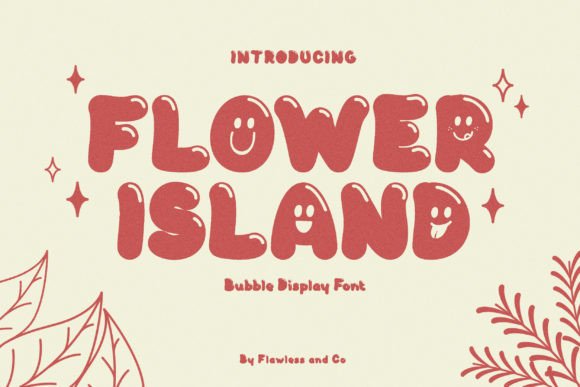
Flower Island: A Playful Display Font for Joyful Editorial Moments
It was a quiet Tuesday morning—coffee still warm, notebook open—and I was sketching the cover layout for a new digital magazine feature on slow living. The theme was gentle, unhurried, full of soft light and intentional pauses. The body text would be set in a warm serif, carefully chosen for its readability across devices. But the title? That needed something else entirely. Something that didn’t shout, but smiled. That’s when I opened Flower Island.
Flower Island is a display font—designed not for paragraphs, but for presence. Its rounded letterforms feel like breath held just right: friendly without being childish, whimsical without sacrificing clarity. There’s a subtle bounce to the rhythm—each curve lifts slightly, each terminal ends with a quiet flourish. It doesn’t mimic handwriting, nor does it lean into strict geometry. Instead, it occupies a thoughtful middle ground: organic, consistent, and quietly confident.
I used Flower Island for the feature’s main headline—“Where Time Slows Down”—and watched how it transformed the whole composition. It didn’t compete with the imagery; it complemented it. The font’s cheerful demeanor softened the contrast between bold typography and delicate photography, making the page feel inviting rather than demanding. That’s the quiet power of a well-chosen display font: it sets tone before a single word is read.
In practice, Flower Island shines brightest where attention matters most. Think of it as your editorial punctuation—the exclamation point you don’t need to shout. It works beautifully on blog headers (especially for lifestyle, wellness, or creative writing blogs), ebook covers (a recipe collection titled *Sunrise Sweets*, a coaching workbook called *Tender Steps*), printable planners (section dividers like “This Week’s Gentle Focus”), and newsletter graphics (a seasonal greeting header or a course launch banner). Its personality supports intentionality—not flashiness.
What makes Flower Island especially useful for real-world publishing is how thoughtfully it balances charm with restraint. Unlike some playful fonts that tip into distraction, Flower Island maintains clean spacing, generous x-height, and consistent stroke contrast. That means it holds up well at medium sizes on screen—say, 36–48px for a newsletter header—and remains legible even in compressed PDF exports or on mobile previews. For printables, it retains its warmth in crisp CMYK output, and its rounded forms avoid harsh edges that can blur at smaller resolutions.
That said, Flower Island isn’t meant for long-form reading. It’s a display font, not a text face—and that distinction matters. I tested it briefly in pull quotes, and while it added lovely emphasis, I quickly paired it with a trusted serif for body copy. That’s where thoughtful font pairing becomes essential. For editorial layouts, I’ve found Flower Island sings alongside a relaxed serif like Adobe Garamond or a clean, airy sans serif like Inter or Lora. Use it for titles, chapter openers, section headings, and decorative accents—never for paragraphs, captions, or navigation menus. Let it lead; let another typeface carry the weight.
For creators building digital products—a printable wedding guide, a self-published poetry chapbook, or a downloadable course workbook—Flower Island adds cohesion without overcomplicating. Its consistency across weights (if included) and support for standard Latin characters make it reliable for English-language content. Before using it commercially—whether embedded in an ebook, licensed for client work, or bundled in a Canva template—I always check the license terms: commercial use permissions, file formats (OTF, WOFF, TTF), multilingual character coverage, and whether stylistic alternates or ligatures are included. These details shape how flexibly it integrates into your workflow.
One afternoon, I set Flower Island beside a handwritten script font for comparison. The difference was telling. The script felt personal but fragile—harder to scale, harder to pair consistently. Flower Island, by contrast, offered personality with structure. It felt like choosing a favorite ceramic mug: familiar, comforting, quietly expressive. That’s why it’s become my go-to for moments when warmth matters more than formality—like the “Thank You” page of a subscriber welcome sequence, or the title of a seasonal reflection guide for creative professionals.
Typography, at its best, isn’t about decoration—it’s about resonance. It’s the reason a reader pauses mid-scroll, leans in, feels seen. Flower Island doesn’t try to be everything. It asks only to be the right thing, in the right place: a breath of air in a crowded feed, a gentle nudge toward joy in a practical layout. It reminds me that even small design choices—like selecting a display font that hums with quiet delight—can deepen connection, reinforce voice, and honor the people on the other side of the screen.
If you’re redesigning a blog header, crafting an ebook cover, or assembling a printable toolkit for your audience, consider what mood you want to extend before the first sentence begins. Flower Island doesn’t solve every typographic challenge—but for those moments when playfulness, warmth, and clarity matter equally, it offers something rare: a display font that feels like kindness made visible.