Halloween Skeleton: A Playful Display Font for Seasonal Brand Moments
It started with a client call — a small creative studio launching a limited-edition Halloween workshop series. Their existing site felt safe, but not *spooky enough*. They wanted something that hinted at whimsy and craft without tipping into cartoonish clutter. So I opened my font library and dropped Halloween Skeleton into the hero headline mockup.
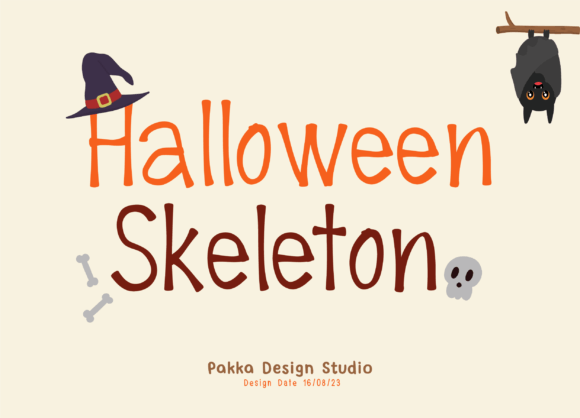
Right away, it clicked. Not because it’s “scary,” but because it’s *alive*. Each letter is a hand-posed skeleton — ribs curve like parentheses, femurs double as crossbars, skulls tilt just slightly. It’s got bounce, asymmetry, and quiet personality. This isn’t a horror-movie font; it’s a display font built for charm, curiosity, and digital delight — perfect for moments where brand voice needs to lean into playful intention.
I tested it across real layout scenarios: over a muted charcoal image banner (with subtle text shadow), in a sticky header on scroll, inside a mobile-first CTA button (“Grab Your Spot”), and as a section divider between workshop modules. In every case, Halloween Skeleton performed like a focused accent — never background noise, always intentional punctuation.
Here’s what stood out in practice:
- It thrives in short bursts. Hero titles, section headers, campaign banners, and course module labels all benefit from its energy. But I avoided using it for body copy, navigation menus, or form labels — not because it’s unreadable, but because its decorative rhythm slows scanning. It’s a spotlight, not a stage light.
- Readability holds up well — with smart constraints. At 32px+ on desktop and 28px+ on mobile (with generous line-height), legibility stays strong. On dark backgrounds, I added a soft 1px white stroke or light drop shadow. Over busy image overlays, I kept contrast high and limited text length — one-line headlines only.
- It pairs effortlessly with calm companions. For this project, I paired Halloween Skeleton with Inter (a neutral, highly legible sans serif) for all body copy, buttons, and interface elements. The contrast worked beautifully: playful headline + grounded structure = clear visual hierarchy and trustworthy tone. For a more editorial feel — say, a seasonal blog series — I’d consider pairing it with a warm, low-contrast serif like IBM Plex Serif or Charter.
On the technical side, I checked what came with the font before dropping it into the build. Halloween Skeleton ships as a web-optimized WOFF2 file, includes uppercase-only glyphs (which fits its display purpose perfectly), and has no italic or bold variants — and that’s fine. Its strength lies in its singular, confident voice. I confirmed commercial licensing covers website use, client projects, and digital templates — essential when delivering assets for a boutique studio or coaching business.
I also paid attention to how it behaved in real-world contexts:
- In a portfolio homepage, it gave a “showcase” vibe to project titles without overshadowing work visuals.
- For a small-batch online store selling handmade candles and ceramic mugs, it added seasonal warmth to banner text like “Spooktacular Sale” — while product names and descriptions stayed in a clean sans serif.
- On a course sales page, it turned module headers (“Bone Up on Typography”) into memorable, on-brand micro-moments — reinforcing theme without sacrificing clarity.
- In a digital brand kit, it served as a secondary display option alongside primary brand fonts — reserved for social graphics, email headers, and limited-time campaign assets.
One thing I appreciated: Halloween Skeleton doesn’t try to be everything. It knows its role. That makes it easier to design *with*, not around. You’re not wrestling with weight options or multilingual glyphs — you’re choosing a precise tool for a specific emotional beat. And in digital branding, where consistency builds recognition and restraint builds trust, that clarity matters.
Of course, it’s not universal. If your brand voice leans minimalist, corporate, or clinical, this font won’t land right — and that’s okay. Halloween Skeleton shines brightest when the goal is connection through character: for creatives, educators, makers, and small businesses that want their digital presence to feel human, hand-crafted, and just a little unexpected.
I also tested fallback behavior. Since it’s a display font, I set the CSS stack thoughtfully: font-family: "Halloween Skeleton", system-ui, -apple-system, sans-serif;. That ensures graceful degradation — no invisible text, no layout shifts — even if the webfont takes a moment to load.
And yes — I checked rendering across browsers and devices. It held up cleanly in Safari, Chrome, and Firefox, including iOS Safari. No glyph substitution issues, no clipping at smaller sizes, and no weird kerning jumps in responsive headlines. That reliability made integration smooth, not stressful.
What surprised me most wasn’t how fun it looked — that was expected — but how *functional* it felt. It guided attention, reinforced theme, and supported storytelling without demanding attention for its own sake. In a world of generic sans serifs and overused script fonts, Halloween Skeleton offers something rare: a display font that’s both expressive and intentional.
If you're building a seasonal landing page, refreshing a creative portfolio, or launching a themed digital product, don’t reach for the first “fun” font you find. Look for one that balances personality with precision — one that enhances your message instead of competing with it. That’s where Halloween Skeleton earns its place: not as decoration, but as deliberate, joyful typography.