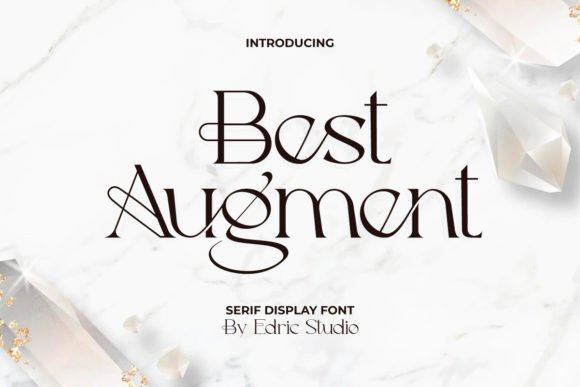
Best Augment Font: A Stylish Serif for Polished Branding
As a small business owner who’s designed everything from coffee sleeve labels to Instagram story templates, I know how much a single font choice can shape how customers perceive my brand. When I first tried Best Augment, it wasn’t just about aesthetics—it was about finding a display font that quietly elevated every customer-facing touchpoint without shouting for attention. This classy serif typeface is thin, refined, and effortlessly elegant—exactly the kind of premium font that makes a boutique, café, or handmade goods brand feel intentional and trustworthy.
What sets Best Augment apart isn’t complexity—it’s restraint. Its clean lines and balanced proportions give it quiet confidence. It doesn’t compete with your message; it supports it. That’s why it works so well as a logo font for a ceramic studio, a header on a wellness coaching website, or the hero text on a seasonal menu at a neighborhood café. Because it’s a display font, Best Augment shines where impact matters most: headlines, signage, packaging accents, and social media banners—not body copy or long paragraphs.
In real-world use, Best Augment adds cohesion across materials that often feel disjointed. Think about your product label, your thank-you card, and your Instagram highlight cover. If each uses a different font—or worse, default system fonts—they don’t feel like part of the same brand. But when you anchor them all with Best Augment for titles and key phrases, and pair it with a clean sans serif (like Inter or Montserrat) for supporting text, suddenly everything feels connected. Customers begin to recognize your voice before they even read the words.
I’ve used Best Augment on candle jars for a local aromatherapy brand—and the contrast between its delicate serifs and minimalist kraft paper packaging made the product feel both artisanal and upscale. For a floral design studio, I applied it to digital thank-you cards and printed workshop flyers. Even at small sizes (like 12–14pt on a sticker), the letterforms hold their shape and remain legible on mobile screens and printed materials alike. It’s not overly ornate, so it avoids the readability pitfalls some script or decorative fonts face on low-resolution surfaces or tight label space.
Here’s where Best Augment fits best in your workflow:
- Logo & wordmarks: Ideal for businesses wanting timeless sophistication—especially in lifestyle, beauty, home décor, or hospitality.
- Packaging & labels: Use it for brand names, scent names, or limited-edition tags—not ingredient lists.
- Social media graphics: Perfect for quote cards, launch announcements, and Pinterest pins where visual tone sets expectations.
- Menus & print collateral: Works beautifully as section headers or featured item names in cafés, bakeries, or salons.
- Website banners & hero sections: Adds instant polish to homepage headlines without slowing load times (it’s lightweight and web-ready).
Font pairing is simple but intentional. Since Best Augment is a serif display font, it pairs naturally with neutral, highly readable sans serifs for contrast and balance. Try it with Open Sans for email newsletters, Lato for product descriptions, or even a warm, friendly serif like Merriweather for longer-form blog content on your site. Avoid pairing it with other high-contrast serifs or overly decorative scripts—that dilutes its quiet authority.
Before rolling Best Augment out across your entire brand, test it in context. Drop it into a mock-up of your actual product label. Paste it into a Canva Instagram post template and zoom out to 25%. Print a sample business card at home and hold it at arm’s length. Does it still feel clear? Does it still feel like *you*? Small adjustments—like tightening letter spacing slightly for caps-only usage or increasing line height when paired with body text—can make a big difference in perceived professionalism.
One practical note many creators overlook: licensing. Best Augment is a commercial font, which means you’ll need the appropriate license if you’re using it on physical products (like tins, mugs, or apparel), client deliverables, digital templates you sell, or downloadable assets. Most reputable font vendors offer clear licensing tiers—look for “desktop + web + app + e-commerce” coverage if you plan to use it broadly. Skipping this step might seem harmless now—but it protects your business down the line.
Real consistency isn’t about using one font everywhere. It’s about choosing one that reflects your values—and then applying it thoughtfully. Best Augment doesn’t try to be everything. It’s not a workhorse body font. It’s not a playful script for kids’ toys. It’s a focused, expressive tool—and that focus is exactly what helps small businesses stand out in crowded markets. Whether you're launching a new skincare line or redesigning your café’s seasonal menu, Best Augment gives your visuals a quiet confidence that says, “We care about the details.” And in a world full of noise, that kind of care is unforgettable.
If you’ve ever hesitated before hitting “publish” on a new ad or second-guessed a packaging proof, consider this: sometimes the smallest design decision—a single, well-chosen display font—can be the most reliable way to show up consistently, clearly, and authentically.