Retro Candy: A Designer’s Real-World Review
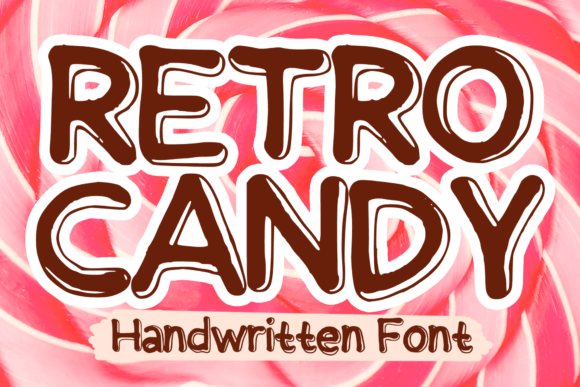
First glance at Retro Candy isn’t just visual—it’s visceral. It lands like a sugar rush: rounded, bouncy, slightly off-kilter, with exaggerated curves and playful weight shifts. This isn’t a nostalgic pastiche; it’s a deliberate, confident reinterpretation of mid-century confectionery signage—think hand-painted soda shop windows and vintage gum wrappers, but tightened, refined, and loaded with intention. As a display font, it doesn’t whisper. It grins, winks, and leans in.
The letterforms feel tactile—soft but structured. ‘O’s are perfectly circular, not squashed or stretched. ‘A’ and ‘M’ have gentle apexes, not sharp points. Even the lowercase ‘e’ has a subtle, generous aperture that breathes without sacrificing charm. There’s warmth in its inconsistency: slight variations in stroke contrast, a hint of uneven baseline rhythm, and terminals that taper like licked lollipops—not sloppy, but *human*. That’s key. Retro Candy avoids the sterility of over-digitized retro fonts. It feels handmade, yet professionally engineered.
Where It Shines (and Where It Doesn’t)
Retro Candy thrives in contexts where personality outweighs neutrality—and where brevity is non-negotiable. It’s exceptional for logo design for bakeries, indie toy shops, boutique skincare lines, craft breweries with playful branding, or children’s book publishers aiming for joy over cutesy. Its strength lies in distilling brand voice into a single, memorable mark. Used as a brand identity cornerstone—paired with a clean sans serif for body copy—it creates instant recognition and emotional resonance.
In packaging design and product labels, Retro Candy delivers shelf impact. On a mason jar of small-batch jam or a matte-finish candle box, it reads as artisanal, approachable, and premium—not cheap or gimmicky. Same goes for merchandise: screen-printed tees, enamel pins, tote bags. Its chunky forms hold up beautifully in print and embroidery.
For social media graphics and digital ads, it works best at medium to large sizes—think Instagram story headers, Pinterest pin titles, or Facebook cover banners. It adds texture and voice to otherwise flat layouts. In editorial design, use it sparingly: pull quotes, section dividers, or masthead accents—not body text, obviously. And yes—it absolutely belongs in Canva templates and Cricut projects, especially for crafters selling printable party kits or DIY decor. Its clean vector outlines scale crisply, and its friendly proportions cut cleanly on vinyl.
Use With Intention—Not Indulgence
Retro Candy is not a workhorse. It’s a spotlight. That means it’s rarely appropriate for web design beyond hero sections or call-to-action buttons. Never use it for navigation, form fields, or paragraph text. Its playful energy actively undermines trust in contexts requiring authority—like financial services, legal disclaimers, or medical information. Likewise, avoid long headlines or multi-line statements. Three words? Perfect. Seven? Risky. Eight? Almost certainly overwhelming.
It excels in short phrases: “Taste the Joy”, “Handcrafted Daily”, “Open Late”. As a brand mark, it’s strong enough to stand alone—even reversed out of color or embossed on kraft paper. For invitations and flyers, pair it with a crisp serif for elegance or a geometric sans for modern contrast. And while it sings on bright backgrounds, test it rigorously on soft pastels or textured substrates—its roundness can blur if contrast dips too low.
Readability, Hierarchy, and Brand Trust
Let’s be clear: Retro Candy trades some readability for character. At 16px on screen? Forget it. At 48px+ in a headline? Instant mood lift. That trade-off is intentional—and valid—for a display font. Its job isn’t legibility at distance or speed; it’s emotional signaling at first glance.
Hierarchy becomes intuitive when you respect its role: Retro Candy sets the tone, then steps aside. Your supporting typeface does the heavy lifting. Done well, this dynamic builds brand consistency and audience trust—because viewers sense intention, not decoration. They understand this isn’t random whimsy; it’s curated confidence. Recognition spikes when used consistently across touchpoints: same weight, same spacing, same context. Overuse dilutes it. Underuse makes it forgettable. Precision matters.
Practical Designer Notes You’ll Actually Use
- Test it in black and white first. Color amplifies Retro Candy—but its structure must hold without it. If it looks weak or muddy in grayscale, reassess.
- Check small-size readability on actual mockups—not just your screen. Print a business card or product tag at 100% scale and hold it at arm’s length.
- Compare uppercase vs. lowercase usage. Uppercase gives bold impact; lowercase offers subtle warmth. Don’t default—choose deliberately.
- Review spacing—kerning especially. Some pairs (like “WA” or “To”) may need manual adjustment in logo lockups. The font includes thoughtful defaults, but fine-tuning pays off.
- Pair it thoughtfully. Try it beside a sturdy serif font (e.g., Playfair Display) for contrast, a neutral sans serif font (e.g., Inter or Montserrat) for balance, a delicate script font for layered elegance, or a rough handwritten font for artisanal depth. Avoid pairing with other display fonts unless you’re intentionally creating high-energy chaos.
- Confirm commercial licensing before any client project or digital product launch. Retro Candy is a premium font—and its license covers commercial font use, but always verify scope: web embedding, app usage, and resale in templates all have nuances.
Retro Candy isn’t for every brand. But for the right one—especially in food, lifestyle, creative education, or handmade markets—it’s a rare find: a creative font that balances authenticity with polish, nostalgia with freshness, and playfulness with professionalism. It doesn’t just sit on the page. It invites interaction. It implies warmth before a single word is read. That’s not decoration. That’s modern typography doing its job—quietly, confidently, and with undeniable sweetness.