Rena: A Retro-Handlettered Display Font That Feels Like a Design Secret
It started with a blank brand board—and that familiar mix of excitement and quiet dread. I was sketching visual identity options for a new neighborhood ceramic studio: small-batch, tactile, warm, quietly confident. No loud slogans, no flashy filters—just honest making. The client had mentioned “vintage charm” and “human touch,” but nothing too cutesy or nostalgic in a costume-y way. So I opened my font library and typed “Rena.”
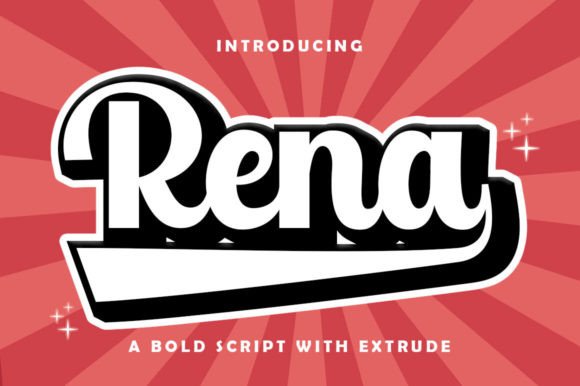
Right away, Rena felt different—not just another script font you’ve seen a hundred times on wedding invites or coffee shop chalkboards. It’s got that unmistakable retro rhythm: subtle bounce, uneven baseline energy, and a hand-lettered looseness that never slips into messy. Think 1950s signage meets a thoughtful designer’s ink sketch—controlled, but breathing. It’s not fussy, and it’s not stiff. It’s present.
I dropped Rena into the logo mockup first—just the studio’s name, all caps, no icon. Instantly, the personality shifted. The swash on the capital “R” gave it motion; the alternate lowercase “a” added quiet sophistication. I toggled through the style sets and landed on one where the terminals softened just enough—not too sharp, not too round—like clay drying in gentle light. That’s when it clicked: Rena isn’t just decorative. It carries tone.
As a display font, Rena shines brightest where attention matters most. I used it for the studio’s sign (mounted wood, matte black paint), business cards (thick cotton stock, blind deboss), and product labels (kraft paper stickers). On each surface, it held its own without shouting. Unlike some script fonts that vanish at small sizes or blur on low-res screens, Rena’s letterforms have enough internal contrast and open counters to stay legible—even at 14pt on a tiny jar label. That said, I wouldn’t use it for body copy. It’s not built for paragraphs. But as a headline font? A logo font? An accent font that introduces warmth and intention? Absolutely.
What really sold me was how easily it played with other typefaces. For supporting text—website body, brochures, Instagram captions—I paired Rena with a warm, slightly rounded sans serif. Nothing neutral or sterile: something with character, like a friendly humanist sans with soft corners and even spacing. The contrast worked beautifully—the script’s organic flow balanced by clean, grounded structure. I also tested it alongside a delicate serif for editorial layouts (think workshop announcements or seasonal newsletters), and the pairing added quiet elegance without competing.
One afternoon, I printed three versions of the same poster: one with Rena alone, one with Rena + sans, one with Rena + serif. Held side-by-side under natural light, the version with the sans felt most cohesive for their audience—craft-conscious but not overly precious. The serif version read more literary; the solo version, while beautiful, leaned too decorative for practical use across their full system. That’s the real value of testing: Rena isn’t a magic bullet. It’s a strong voice—but it needs the right supporting cast.
The alternates and ligatures made all the difference in fine-tuning. That initial “Ceramic Studio” lockup? I swapped in a custom ligature for the “st” combo—it wasn’t essential, but it added a whisper of craft, like a signature tucked into the design. And the swashes? Used sparingly: only on the first letter of the studio name in large-scale applications (shop front, website hero), never on social thumbnails where space is tight. Overuse would dilute its impact. Rena rewards restraint.
I also checked the technical details before locking anything in. Rena comes with OpenType features—standard and discretionary ligatures, stylistic sets, and contextual alternates—all accessible in Illustrator, InDesign, and modern web environments via CSS @font-face (with proper variable support). No missing glyphs for common European languages, and the file formats included both OTF and WOFF2 for flexible use across print and digital assets. Licensing was clear: commercial use included, no hidden fees for merch or web embedding. As a freelancer, that peace of mind matters—especially when handing off files to a client who’ll update their site or order new stickers down the line.
In practice, Rena performed consistently across mediums. On their homepage hero section, it loaded cleanly and retained its weight and contrast—even on older mobile browsers. On Instagram posts, it stayed crisp in both square and vertical crops. Printed on uncoated paper? Still charming. Laser-etched onto ceramic coasters? Surprisingly graceful. It adapts without losing its core identity.
Of course, I didn’t jump straight to final files. I exported PDF proofs at actual size—business card, label, sign—and reviewed them on screen *and* printed. I asked two non-designer friends (one who runs a flower shop, one who teaches pottery) to glance at the logo and tell me the first three words that came to mind. “Warm,” “crafted,” and “trusted” came up twice. That told me Rena wasn’t just pretty—it was doing its job.
If you’re weighing Rena for your next branding project, here’s what I’d suggest: start with the logo and one key application—maybe packaging or a social banner. Try at least two pairings: one sans serif, one serif. Toggle through the stylistic sets early; don’t wait until finals. And remember—it’s a display font, so let it lead, then step back. Its strength isn’t versatility across every use case, but depth within the right ones.
Rena won’t solve every typographic challenge. But for projects where authenticity, tactility, and quiet confidence matter—where you want your type to feel like part of the story, not just decoration—it’s become one of those rare fonts I reach for without second-guessing. Not because it’s trendy, but because it’s thoughtful. And in a world of endless fonts, that’s worth highlighting.