Chalk and Eraser: A Display Font That Feels Like a Warm Handwritten Note
Last Tuesday, I was finalizing the cover layout for a seasonal newsletter—a quiet, slow-living guide with recipes, garden notes, and gentle reflections. The body text was set in a warm serif, comfortable at any size. But the title? It needed to breathe—not shout, not dazzle, but invite. That’s when I opened Chalk and Eraser. Within minutes, the header felt like it had always belonged there: soft-edged, lightly textured, effortlessly legible, and quietly full of character.
A Typeface That Prioritizes Clarity Without Losing Charm
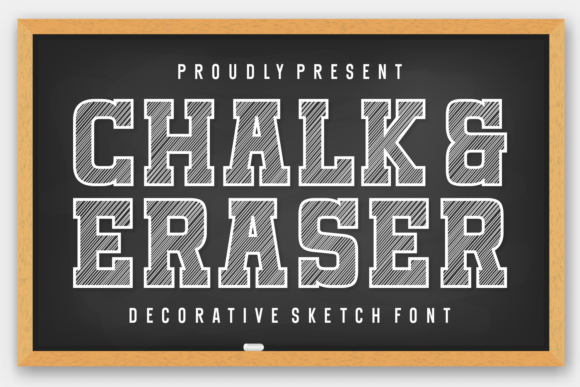
Chalk and Eraser is a display font—designed not for paragraphs, but for moments where tone matters as much as meaning. Its letterforms echo hand-drawn chalk: rounded terminals, gentle irregularity in stroke weight, subtle tapering on curves, and just enough asymmetry to feel human—not algorithmic. Yet unlike many handwritten or script fonts, it avoids excessive flourish or ambiguity. Every glyph remains distinct, even at smaller sizes—say, 24pt on a mobile screen or 36pt in a PDF chapter opener. That balance—friendliness without fuzziness—is rare.
Where It Finds Its Rhythm in Real Layouts
In editorial use, Chalk and Eraser settles most naturally into roles that benefit from warmth and approachability: blog headers, ebook titles, worksheet headings, printable planner covers, pull quotes in digital magazines, and greeting card banners. I used it for section dividers in a coaching workbook—each chapter began with a short, centered phrase in Chalk and Eraser over a muted background. Readers told me those moments “felt like pausing to take a breath.” That’s not accidental. The font’s generous x-height and open counters support quick recognition, while its relaxed spacing encourages a slower, more intentional reading pace.
It also works beautifully in layered layouts—like a recipe ebook where the dish name appears in Chalk and Eraser above a clean sans serif ingredient list, or a wedding guide where ceremony tips are introduced with a delicate Chalk and Eraser heading before flowing into elegant serif body copy. In each case, the font acts as an editorial hinge: it signals a shift in voice, not just hierarchy.
What It Does—and Doesn’t—Do Well
Chalk and Eraser is not intended for body text. Its expressive nature would fatigue readers in long-form passages, and its limited weight range (typically one regular weight, sometimes with light or bold alternates) means it lacks the typographic flexibility needed for dense content. Small captions, footnotes, navigation menus, or data-heavy tables are better served by a neutral sans serif or a highly readable serif. Likewise, formal reports, academic publications, or legal templates call for precision over personality—places where Chalk and Eraser’s gentle imperfection would feel out of step.
On screens, it performs well at headline sizes (20pt and up), especially with anti-aliasing enabled. In PDF exports, it renders cleanly across devices—no pixelation, no unexpected spacing shifts—provided the font is embedded. For printables, it holds texture beautifully: the slight chalky grain translates well to matte paper, adding tactile warmth without compromising legibility.
Thoughtful Pairings That Ground Its Personality
Like any strong display font, Chalk and Eraser shines brightest when paired intentionally. My go-to pairings lean into contrast and calm: a classic serif like Merriweather or EB Garamond for body text, offering structure and rhythm beneath Chalk and Eraser’s soft cadence; or a restrained sans like Inter or Lato for captions, buttons, and sidebars—clean, functional, and quietly modern. What works less well is pairing it with other expressive fonts: two handwritten styles compete for attention, and overly geometric sans serifs can clash with its organic flow.
I’ve also found success using Chalk and Eraser alongside simple line art or watercolor textures—its handmade quality harmonizes naturally with analog-inspired design assets. In a digital magazine layout, it anchored illustrated feature headers without overwhelming the imagery. In a printable planner, it gave section labels presence without demanding center stage.
Practical Notes Before You Use It
Before integrating Chalk and Eraser into client work, templates, or paid digital products, check what’s included: does it offer OpenType features like stylistic alternates or ligatures? Are there language extensions beyond basic Latin? Is multilingual support present for common European or extended character sets? File format matters too—OTF files tend to render more consistently across platforms than TTF in professional publishing workflows. And crucially: verify the commercial license covers your use case—whether that’s embedding in an ebook, licensing for client branding, or bundling with a printable course PDF.
It’s not a “do-everything” font. But as a display typeface, Chalk and Eraser delivers something increasingly rare in digital typography: presence without pressure, friendliness without fuss, and clarity without compromise. It doesn’t try to be everything—it simply makes certain kinds of communication feel kinder, clearer, and more human.