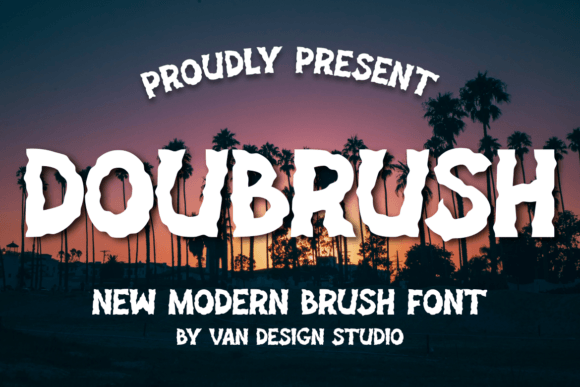
Doubrush: A Playful Display Font for Handmade Charm
It was 7 a.m., coffee still steaming, and I was deep in the final round of mockups for my new lavender-honey candle line. The scent notes were perfect, the wax blend tested three times—but something felt off on the label. The clean sans serif I’d been using looked crisp, yes, but also… forgettable. Like it belonged on a tech manual, not a hand-poured candle meant to evoke slow mornings and sunlit windowsills. That’s when I opened Doubrush.
Doubrush is a display font with personality—quirky without being chaotic, friendly without tipping into cutesy. Its rounded terminals, gentle asymmetry, and subtle bounce give it warmth and approachability, like handwriting that’s had just enough practice to feel confident, but not so much that it loses its human rhythm. It’s not a script, not a serif, not a geometric sans—it lives in that joyful middle ground where handmade energy meets thoughtful design.
I typed “Lavender & Honey” in Doubrush, set it at 32pt on a kraft paper label preview, and instantly exhaled. There it was—the voice I’d been trying to give the product. Not loud, not flashy, but unmistakably present. That’s the magic of a well-chosen display font: it doesn’t shout your message. It invites someone to lean in and read it.
Doubrush shines brightest where attention matters most—on physical touchpoints customers hold, pause over, or photograph. Think candle labels printed on textured stock, greeting cards with foil-stamped headlines, wedding welcome boards leaning against a rustic barn door, or printable wall art designed to soften a nursery wall. It’s equally at home on digital downloads—planner covers, sticker sheets, and social media story templates—where its character adds instant visual distinction amid scrolling feeds.
Because Doubrush is a display font by nature, it’s built for impact, not endurance. Use it for short, meaningful phrases: product names (“Wild Mint Soap”), event titles (“Summer Solstice Gathering”), collection headers (“Farmhouse Favorites”), or decorative accents (“Hand-poured • Small-batch • Made with care”). Avoid body text or long paragraphs—it wasn’t designed for extended reading, and your customers will feel that strain, even if they can’t name why.
Readability is key—especially when cutting vinyl or printing tiny tags. Doubrush holds up beautifully at 18–24pt on 2" x 3" boutique tags and stays legible down to 14pt on matte-finish stickers (I tested this on a sheet of 1.5" circle stickers for tea towels). For Cricut or Silhouette users: the letterforms have generous counters and open spacing, so intricate cuts stay crisp—even with fine-tipped blades and medium-weight cardstock. Just avoid ultra-thin weights or overly tight tracking when scaling below 12pt.
Pairing Doubrush thoughtfully elevates both fonts. My go-to companion is a warm, low-contrast sans serif—something like Montserrat Light or Lato Regular—for supporting text on labels and cards. The contrast gives Doubrush room to breathe while keeping information clear and grounded. For wedding stationery, I’ve paired it with a delicate serif (Cormorant Garamond) for ceremony details—Doubrush handles the “Mr. & Mrs.” headline, while the serif carries the elegance of time and tradition. And yes, you *can* pair it with another script—but keep it minimal. One playful font is enough. Let Doubrush be the star; let the secondary typeface serve the story.
Before using Doubrush commercially—whether on mugs, tote bags, digital templates, or SVG files for crafters—always check the license. Most reputable display fonts include full commercial rights, but verify whether it covers merchandise, print-on-demand, editable digital downloads, or resale as part of a design bundle. Also peek inside the file: does it include stylistic alternates? Swashes for initials? Uppercase-only versions for bold signage? Multilingual glyphs for shops serving diverse communities? These small details make a real difference when designing bilingual holiday tags or packaging for international markets.
I’ve used Doubrush across seasons—softened with sage green ink for spring plantable seed cards, layered in gold foil for holiday gift tags, scaled large and painted freehand on a reclaimed wood sign for my shop’s summer pop-up. Each time, it adapts without losing its core charm. It doesn’t force a mood—it reflects the intention behind it. That’s rare in typography, especially in display fonts that risk feeling gimmicky.
What surprised me most wasn’t how well Doubrush worked on physical products—it was how consistently it strengthened brand recognition. Customers started mentioning “that friendly font” unprompted—not because it was flashy, but because it felt intentional, human, and quietly memorable. In a marketplace crowded with polished-but-impersonal aesthetics, Doubrush helps handmade makers signal authenticity without saying a word.
If you’re choosing fonts for your next batch of planner pages, seasonal sticker sets, or boutique packaging, consider what emotion you want to land first. Calm? Joyful? Nostalgic? Grounded? Doubrush leans gently toward warmth and whimsy—never childish, never forced. It’s the kind of display font that makes people smile before they even read the words. And in handmade business, that first impression is where connection begins.
So next time you’re staring at a blank label template or sketching a mug design, try typing your product name in Doubrush—not as decoration, but as dialogue. Let the font ask the question your brand already answers: “Would you like to stay awhile?”