Locker: A Display Font That Makes Handmade Goods Shine
There’s that moment—right after you’ve poured your third small-batch soy candle, wiped the wax from your counter, and opened your design software to finalize the label—when you pause. You want something that feels intentional, elevated, but still warm and human. Not too fussy. Not too plain. Just right. That’s when I reached for Locker.
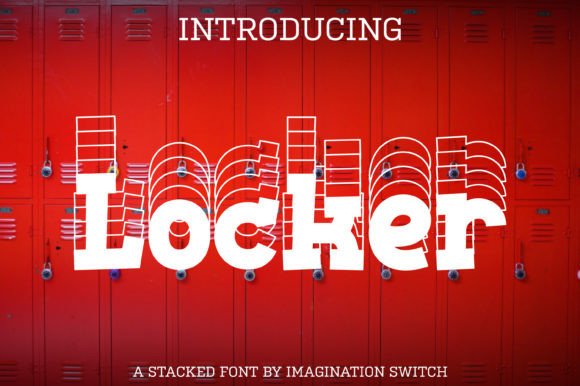
Locker is a display font with an elegant stacked structure—each letter rises like a gentle tier, giving it subtle dimension and quiet confidence. It’s not flashy, but it *holds space*. When I typed “Honey Lavender” in Locker on a kraft paper candle label mockup, the letters didn’t just sit there—they seemed to settle into the texture, like they belonged. That’s the magic of a well-chosen display font: it doesn’t shout, but it makes people lean in.
I’ve used Locker across real handmade projects—no hypotheticals, no fluff. On matte-finish greeting cards for birthdays and anniversaries, it gives names and short sentiments a soft gravitas. On wedding welcome boards printed on birch plywood, its stacked rhythm echoes the layered elegance of floral arches and linen runners. For printable wall art—think minimalist botanical quotes or cozy seasonal phrases—it adds crafty sophistication without competing with the illustration. And on digital planner pages? Locker shines as section headers (“Weekly Intentions,” “Gratitude Log”)—clean enough for screen reading, distinctive enough to feel curated.
What makes Locker especially useful for makers is how thoughtfully it balances presence and readability. It’s designed for display use—not body text—so it thrives where attention matters most: product names, shop tags, boutique packaging headers, mug decals, tote bag slogans, and seasonal sticker sheets. I tested it at 12pt on a 1.5-inch round sticker (for a mini candle line), and it held up beautifully—no pixelation, no lost detail. For Cricut and Silhouette users, it cuts cleanly at sizes 14pt and up, especially when exported as SVG or high-res PNG. Just avoid cramming more than 3–4 words in tight spaces; let Locker breathe.
One thing I love about Locker is how it supports brand consistency without feeling rigid. Whether I’m designing holiday gift tags for a local yarn shop or previewing digital download templates for planners, Locker becomes a quiet throughline—a visual whisper that says, “This was made with care.” It doesn’t scream “luxury,” but it quietly signals quality. Customers don’t notice the font itself—they notice how the whole piece feels *resolved*, intentional, cohesive.
It pairs effortlessly with other typefaces, too. For labels and packaging, I often pair Locker with a friendly sans serif (like Montserrat or Poppins) for ingredients, care instructions, or small print—clean contrast without visual tension. On wedding invitations, a delicate script font (with restrained swashes) works beside Locker for names, while a simple serif handles RSVP details. And for farmhouse-style signs or printable quote art? Locker + a sturdy, low-contrast serif (think Lora or Merriweather) creates grounded, timeless harmony.
Before using Locker commercially—on physical goods, digital templates, or SVG cut files—I always double-check the license. The version I use includes OTF and TTF files, basic OpenType features (ligatures and stylistic alternates), and full commercial rights for unlimited physical products and digital downloads. No hidden limits. No surprise restrictions on Etsy listings or Canva templates. It also supports extended Latin characters, so it handles accents and diacritics gracefully—handy for bilingual greeting cards or international shop branding.
I’ve used Locker on everything from hand-stamped leather tags (via laser-printed transfer sheets) to heat-pressed cotton tees, and even vinyl-cut wooden coasters. On mugs, it holds up best when used for single-line phrases (“Good Morning, Sunshine”) rather than paragraphs—its charm lives in clarity and form, not density. Same goes for tote bags: bold, centered, and generously spaced. When scaled down for QR code labels or tiny jar seals, I stick to uppercase-only settings and avoid thin weights (if available)—but since Locker is a single-weight display font, its built-in robustness means it rarely needs adjustment.
What sets Locker apart isn’t just its stacked silhouette—it’s how it invites warmth into precision. It doesn’t try to be trendy. It doesn’t chase algorithms. It simply offers makers a tool that feels like a natural extension of their hands-on process: thoughtful, tactile, and quietly confident. Whether you’re printing 10 custom wedding napkins or uploading your 50th digital printable to Etsy, Locker helps your work land with sincerity—not noise.
If you're choosing fonts for your next batch of handmade goods, ask yourself: does it reflect the care behind the craft? Does it support the mood—not override it? Does it scale well across stickers, labels, screens, and signage? Locker answers yes—to all three. It’s become my go-to for moments when the words matter, the presentation counts, and the making is deeply personal.
And honestly? That candle label I started with—the one that made me pause mid-design—it shipped last week. Two customers mentioned how “the label felt special.” They didn’t name the font. They named the feeling. That’s the power of choosing the right display font.