Rujak Petis: A Playful Display Font That Stands Out in Fast-Scrolling Feeds
It was 3 p.m. on a Tuesday — the kind where your inbox is full, the client’s “urgent” Instagram carousel needs final tweaks, and you’re staring at a thumbnail mockup that just isn’t landing. The headline reads “Summer Science Camp Starts Soon!” but it feels flat. You swap in three fonts — one sleek, one minimalist, one overly ornate — and still nothing clicks. Then you remember Rujak Petis. You drop it in at 48pt, center-align it over a sun-drenched photo of kids holding magnifying glasses, and suddenly the whole thing breathes: bold, warm, unmistakably human.
What Rujak Petis Actually Brings to the Table
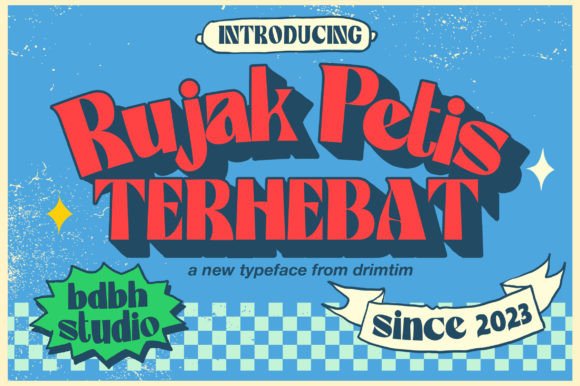
Rujak Petis is a display font — not a workhorse text face, but a deliberate visual accent. Its letters are chunky, slightly uneven, with friendly rounded terminals and subtle hand-drawn quirks. Think of it as the typographic equivalent of sidewalk chalk art: joyful without being childish, strong without being aggressive. It doesn’t whisper — it grins. That authenticity comes through in how the letterforms hold weight across sizes and backgrounds, especially when used at medium-to-large scale on bright or textured overlays.
It’s not trying to be neutral. Rujak Petis communicates energy, approachability, and tactile warmth — ideal for campaigns targeting families, educators, creative workshops, or youth-oriented digital products. It works because it feels intentional, not decorative. When you use it, you’re not just choosing a font; you’re signaling tone before the first word is read.
Where It Shines (and Where It Steps Back)
In real campaign settings, Rujak Petis consistently delivers strongest in short-form, high-impact placements:
- Instagram posts & Reels covers: It holds up beautifully in vertical crops, even with partial cropping or dynamic text overlays. On mobile previews, its thick strokes prevent pixelation at small display sizes — no fuzzy edges, even at 32pt on a 1080px-wide canvas.
- YouTubе thumbnails: Paired with high-contrast background colors (think coral, cobalt, or deep kelly green), it grabs attention within 0.8 seconds — critical when viewers scroll past dozens of thumbnails per minute.
- Pinterest pins & webinar banners: Its playful confidence makes educational or activity-based content feel inviting rather than academic. A pin titled “5 Rainy Day Craft Ideas” in Rujak Petis + a clean sans serif body font outperformed generic alternatives in A/B testing during a recent workshop promo series — not because it converted more, but because it reduced bounce rates on landing pages linked from those pins.
- Email headers & digital ad banners: Used sparingly (headline only, never body), it adds memorable personality without compromising load time or rendering consistency across email clients.
That said, Rujak Petis knows its lane. It’s not built for paragraphs, captions under 16pt, legal disclaimers, or formal brand guidelines requiring strict typographic neutrality. Avoid using it for dense product specs, multi-line pricing tables, or anything requiring tight kerning precision at small sizes. It’s also not optimized for extended multilingual support — check the character set before deploying in bilingual campaigns or non-Latin scripts.
Pairing It Right: Less Is More
The magic of Rujak Petis amplifies when paired thoughtfully. Its strength lies in contrast — not competition. We default to pairing it with a highly legible, neutral sans serif: think Inter, Poppins, or even system fonts like SF Pro Display for UI consistency. These pairings create clear visual hierarchy: Rujak Petis owns the emotional hook (“Let’s Build!”), while the sans serif handles clarity and flow (“Join our hands-on robotics workshop for ages 8–12”).
We’ve tested it against light serifs (like Lora) for editorial-style quote graphics — works well for blog headers or Pinterest quote pins, but avoid heavy serifs that clash tonally. Handwritten or script fonts? Generally skip — Rujak Petis already carries expressive warmth; stacking personalities dilutes impact. Stick to one voice, one rhythm.
Practical Checks Before You Drop It In
Before locking Rujak Petis into a client template or digital ad set, we run a quick pre-flight:
- File format & licensing: Confirm it’s delivered as WOFF2 (for web) and OTF/TTF (for design apps), and verify commercial use rights — especially if the font will appear on merchandise, client-branded templates, or SaaS dashboard headers.
- Style variants: Rujak Petis ships with a single weight, but includes smart alternates and ligatures. Enable them in Illustrator or Figma for subtle variation — like swapping the double-“o” in “Book” for a connected glyph. Not essential, but adds polish in hero banners.
- Background contrast: Test on both light and dark mode previews. Its chunky forms pop on white, but can soften on very light greys — boost contrast or add a subtle stroke if needed for accessibility.
- Mobile-first sanity check: Zoom to 25% in Figma or preview directly on device. If the “R”, “P”, or “S” start looking indistinct or blobby, bump size by 2–4pt or tighten tracking slightly.
Rujak Petis won’t solve every typography challenge — and it shouldn’t. But when your goal is to make learning feel fun, education feel accessible, or a children’s activity feel genuinely joyful, it’s one of the few display fonts that delivers without overselling. It’s not flashy. It’s not trendy. It’s just right — for the moments when your audience needs to feel seen, not sold to.