Bedebah: A Bold Display Font That Commands Attention
I opened a fresh brand board last week for a local ceramicist’s rebrand—hand-thrown mugs, earthy glazes, quiet studio energy—and immediately reached for something with weight and presence. Not delicate. Not minimalist. Something that felt made, not just arranged. That’s when I dropped Bedebah into the logo draft. And honestly? It clicked faster than most fonts do on first try.
What Bedebah Actually Feels Like in Real Work
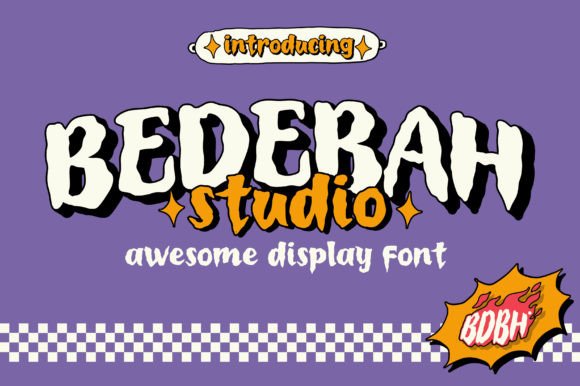
Bedebah is a display font—no question about it. It’s bold, thick, tightly spaced, and built for impact, not endurance. The letters have a grounded, almost architectural confidence: strong verticals, subtle flaring at terminals, and a slight forward tilt that gives movement without sacrificing stability. It doesn’t whisper—it states. But crucially, it does so without shouting in an uncontrolled way. There’s intention in its density, rhythm in its weight distribution.
I tested it across six touchpoints: a hand-printed product label (for clay tags), a matte-finish business card, a café-style storefront sign mockup, a hero section on a simple portfolio site, an Instagram post announcing a new workshop series, and a small-run t-shirt design. In every case, Bedebah held up—not because it was “versatile” in the generic sense, but because its personality matched the context where boldness mattered most.
Where It Shines (and Where It Doesn’t Pretend To)
Logo design? Absolutely—if your brand leans into craft, energy, or authenticity. On the ceramicist’s logo, Bedebah gave the name instant gravitas without needing extra graphic elements. Paired with a clean, neutral sans serif (I used Inter Light for body text), it created a clear visual hierarchy: the name anchors, the details breathe.
Packaging and product labels? Yes—but only for short, high-impact copy. Think “STONED,” “HAND-THROWN,” or “MADE IN OAKLAND.” At 14pt on a 2” x 3” tag, it remained legible and confident. At 8pt? No. It’s not built for fine print, and pretending otherwise dilutes its strength.
Social media graphics? Especially effective for square or vertical posts where you need one phrase to land fast—like “NEW GLAZES DROP FRIDAY” over a textured background. Its thickness holds up well against busy imagery or grainy photos.
Web headers? Works beautifully at 48–72pt on desktop, especially with letter-spacing tightened slightly (-20–-40). Just avoid using it for navigation menus, paragraph headings, or anything requiring scanning speed. It’s a headline font, not a utility font.
Business cards and printed collateral? Surprisingly elegant in black ink on soft white cotton stock. The weight reads as substantial, not aggressive—more “thoughtfully solid” than “loud.”
Pairing It Without Overcomplicating Things
Bedebah doesn’t beg for fancy pairings. In fact, it thrives when contrasted simply: a sturdy sans serif for body copy (Inter, Poppins, or even Helvetica Now) keeps things grounded and readable. I tried it with a warm serif (Cormorant Garamond) for a brochure layout—nice tension, but only for headlines and pull quotes. Too much serif + Bedebah started feeling like a typography duel instead of a conversation.
Avoid pairing it with other display fonts unless you’re deliberately going maximalist (e.g., a festival poster or limited-edition merch). And skip script or handwritten fonts unless the project is intentionally playful—Bedebah’s tone is too direct to bend easily into whimsy.
Practical Notes Before You Commit
Bedebah comes as a single weight—bold, no italics or light variants. That’s by design. It’s not meant to be a full typography system; it’s a focused tool. If your brand needs multiple weights for UI or editorial flexibility, pair it with a robust companion family, not expect Bedebah to stretch.
No ligatures, no swashes, no alternates—just clean, confident letterforms. That simplicity is part of its reliability. It also includes basic Latin multilingual support (accents for French, Spanish, German, etc.), which covered everything needed for the ceramicist’s bilingual signage.
File formats are standard: OTF and WOFF2 included, so web use is straightforward. Just remember—this is a commercial font. Always verify licensing before using it in client work, templates, merchandise, or digital products. Most foundries offer clear desktop + web bundles, but resale or SaaS embedding requires separate permissions.
When to Reach for Bedebah (and When to Pause)
Reach for Bedebah when you need a name, phrase, or concept to feel unignorable—but still human-made. It works beautifully for handmade shops, indie apparel lines, neighborhood restaurants, creative studios, and any brand that values tactile quality and visual confidence.
Pause if your project demands subtlety, neutrality, or extended reading. Don’t force it into body text, legal disclaimers, or corporate annual reports. It’s not unfriendly—it’s just not built for compromise.
One last real-world note: I printed a few test versions of the ceramicist’s business card at different DPIs and paper stocks. Bedebah held its shape perfectly—even on uncoated stock at 300dpi. No bleeding, no loss of definition. That kind of reliability matters more than theoretical specs.
Bottom line? Bedebah isn’t trying to be everything. It’s a premium display font that knows exactly what it is—and delivers it, consistently, without fuss. For designers who value clarity, craft, and a little controlled boldness, it’s less of a “font choice” and more of a trusted collaborator.