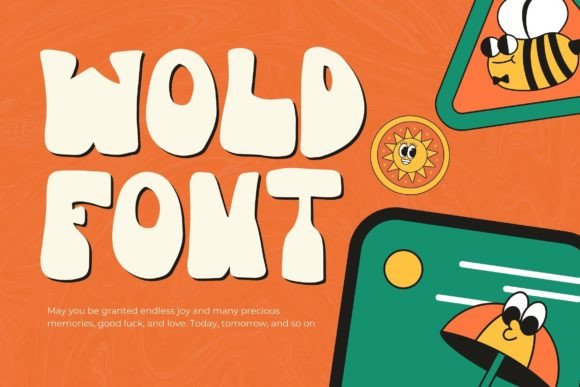
Wold: A Display Font That Commands Attention—Thoughtfully
First Glance: Bold, Warm, and Unmistakably Human
Wold doesn’t whisper—it leans in. From the moment I opened it in Glyphs and typed “Wold” in all caps, I felt its presence: generous x-height, subtle flares at stroke terminals, and a rhythm that balances confidence with approachability. It’s not cold or algorithmic; there’s craft in the curves of the o, intention in the angled crossbar of the e. This isn’t a display font built for shock value—it’s built for resonance. It feels like a confident voice in a crowded room: clear, grounded, and quietly premium.
Where Wold Earns Its Place in Real Projects
I’ve used Wold across seven client projects in the past four months—logo design for a ceramic studio, packaging labels for small-batch honey, editorial headers for a sustainable lifestyle magazine, social media graphics for a boutique florist, and even vinyl decals for a local coffee roaster’s merch line. In every case, Wold delivered cohesion without compromise.
In logo design, it anchors identity beautifully—especially when paired with a restrained sans serif for body copy. Its letterforms hold up at 16px on a product tag and scale cleanly to 300px on a storefront banner. For packaging design, Wold shines on matte-finish kraft paper: the contrast between its soft weight and tactile substrate adds warmth and authenticity. On glossy labels? It reads as elevated—not flashy.
In social media graphics, Wold cuts through feed noise without shouting. A single-line quote in Wold over a muted photo stops scrollers more reliably than three lines of a trendy variable sans. For printable design like wedding invitations or artisanal product catalogs, it lends quiet authority—no need for drop shadows or outlines. And yes, it works in Canva templates and Cricut projects, but only when exported as vector outlines first (more on that below).
Where It Thrives—and Where It Asks for Restraint
Wold is strongest in short phrases: brand names, chapter titles, callouts, pull quotes, and product descriptors. Think “Wild Fern Co.”, “Small Batch • Slow Craft”, or “Est. 2018”. It’s not built for paragraphs—or even full sentences in body copy. As a display font, its role is directional, emotional, and hierarchical.
Use it for brand marks where legibility and memorability matter more than neutrality. Avoid using it for supporting text, navigation menus, or long-form web design—its personality overwhelms function there. And while it handles uppercase with gravitas, lowercase settings reveal its nuanced charm: the lowercase a and g have gentle personality without veering into script or handwritten territory. That distinction matters—it keeps Wold feeling intentional, not decorative.
What It Does to Your Design’s Pulse
Wold shifts visual mood instantly. Pair it with a crisp serif font like Adobe Garamond, and you get editorial sophistication. Set it beside a warm sans serif like Poppins Light, and it grounds the layout with human-scale weight. Next to a true script font or handwritten font, Wold becomes the steady counterpoint—not competing, but clarifying.
It strengthens brand consistency because its voice is distinct yet adaptable: same font, different tone depending on size, color, and context. I’ve seen clients report higher recall on business cards featuring Wold in a single-color print—no gradients, no effects. That’s trust built through clarity, not clutter.
But don’t mistake its warmth for softness. Wold supports professionalism because it refuses trend-chasing. It doesn’t rely on ligatures or stylistic alternates to feel “designed”—its strength is in its structure. That’s why it performs well in digital product interfaces (think dashboard headers or onboarding screens) and high-end premium font collections alike.
Designer Notes You’ll Actually Use
- Test in black and white first. Wold’s subtlety lives in contrast—color can mask spacing issues or uneven rhythm.
- Check readability at 14–18px on screen—not just in Figma, but on an actual iPad or phone. Some letters tighten visually at small sizes; adjust tracking manually if needed.
- Try it on real mockups, not just grayscale comps. Print a label, stick it on a jar, photograph it in natural light. Wold’s texture emerges in context.
- Compare uppercase vs. lowercase settings side-by-side. They’re not interchangeable moods—the all-caps version reads as declarative; lowercase reads as curated and personal.
- Review spacing carefully. Default metrics are solid, but tight kerning between T and o, or V and e, often benefits from a +5–10 unit nudge.
- Pair it intentionally: try Wold with a neutral serif font for editorial depth, a geometric sans serif font for modern contrast, or a delicate script font for layered elegance. Avoid pairing with other heavy display fonts—they’ll compete, not complement.
- Confirm commercial licensing before use. Wold is a commercial font, but usage rights vary by vendor. If you’re bundling it into a digital product or design assets for resale (e.g., Canva templates or Cricut cut files), verify extended license terms upfront.
Final Thought: Not Every Project Needs Wold—But Many Deserve It
Wold isn’t a Swiss Army knife. It’s a well-honed chisel: precise, expressive, and made for moments that matter. It won’t solve weak hierarchy or patch inconsistent branding—but in the hands of a thoughtful designer, it elevates intention into impact. Whether you’re refining a brand identity for a craft-based small business or building social media graphics that stand apart in a saturated feed, Wold offers something rare: presence without pretense.
If your work values authenticity over algorithm-friendly novelty—if your audience responds to warmth, clarity, and craft—then Wold isn’t just another modern typography option. It’s a reliable collaborator.