James College: A Bold Display Font That Commands Attention
It was 3:47 p.m. on launch day—my client’s “Summer Studio” online course series was going live in six hours, and the Instagram carousel needed final tweaks. I opened the thumbnail mockup for the first reel: a warm, sun-drenched photo of sketchbooks and coffee, overlaid with a short headline—“Your Creative Breakthrough Starts Here.” The current font felt polite. Too polite. It blended. I swapped it for James College.
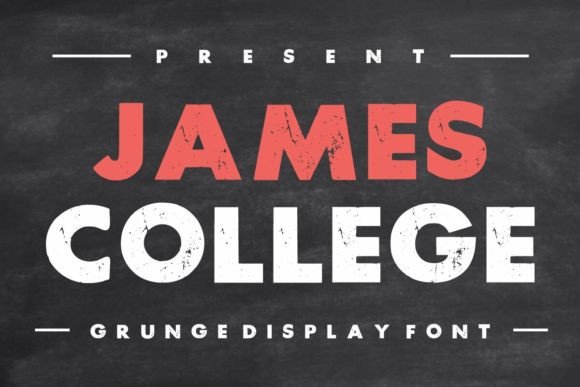
Instantly, the tone shifted—not louder, but more certain. That’s the thing about James College: it doesn’t shout to be seen. It arrives like a confident voice in a crowded room—grunge-tinged, vintage-rooted, unapologetically bold. As a display font, it’s built for impact, not exposition. Its thick strokes, slightly uneven baseline, and subtle texture give it character without sacrificing legibility at scale.
Where James College Earns Its Place in Real Campaigns
In digital-first workflows, James College shines where personality and brevity intersect. Think:
- YouTube thumbnails — It holds up crisply even when scaled down to 120px tall. On a busy feed, its weight and rhythm stop the scroll faster than a generic sans serif.
- Instagram post headers and Reels covers — Paired with a clean sans (like Inter or Montserrat), James College anchors the visual hierarchy. It works especially well over textured backgrounds or muted gradients—its grunge edge softens into warmth, not noise.
- Pinterest pins and email banners — Because it’s designed as a display font, not body text, it performs best in short, high-intent phrases: “Limited Seats,” “New Collection,” “Free Guide Inside.” Not paragraphs. Not disclaimers.
- Webinar banners and digital ad headlines — On mobile previews, James College remains readable at 28–36px. Its letterforms open wide enough to avoid clumping on small screens—even over semi-transparent overlays.
What It Communicates—Without Saying a Word
James College carries mood like scent: vintage, grounded, creatively restless. It’s not retro pastiche—it’s got the authenticity of a well-worn zine cover or a hand-printed concert poster from the early 2000s. That makes it ideal for brands or creators who want to signal craft, independence, or thoughtful rebellion—not chaos, not irony, but intention.
It reads as human-made, which matters in feeds saturated with algorithm-perfect templates. When used for a quote graphic (“Trust the messy middle”), it adds emotional weight. For a seasonal sale banner (“Fall Edit: Live Now”), it feels curated—not automated.
Where It Works—and Where It Doesn’t
Be honest: James College isn’t for everything. It’s not meant for:
- Body copy, captions under 20px, or dense product descriptions.
- Formal corporate reports, legal disclaimers, or financial dashboards.
- Long headlines on low-resolution ads or tiny app notifications.
Its strength is declarative energy—not nuance. Use it for the label, not the footnote. For the campaign name (“The Analog Reset”), not the bullet list beneath it.
Smart Pairing Keeps It Balanced
I almost always pair James College with a neutral, highly legible sans serif—something with open counters and generous spacing, like Inter Medium or Manrope Regular. That contrast does two things: it lets James College breathe as a statement, and it ensures supporting text stays frictionless to read.
For more editorial or lifestyle projects, I’ve tested it with a quiet serif (e.g., IBM Plex Serif Light)—especially in print-ready planners or greeting card suites. Avoid pairing it with other decorative or script fonts unless you’re intentionally building layered texture (and even then, limit it to one accent).
Practical Checks Before You Drop It Into Production
Before committing James College to client work or templates, I scan for:
- File formats: Does it include .woff2 for web use? .otf/.ttf for design apps and merch? Check licensing—some versions allow commercial use in digital ads; others restrict resale in template packs.
- Weights & alternates: James College is typically single-weight, but verify if stylistic sets or ligatures are included. Even small variations (like alternate ‘a’ or ‘g’) add polish to logo-style treatments.
- Language support: If your audience includes Spanish, French, or Scandinavian markets, confirm extended Latin characters are covered—not just basic A–Z.
- Background contrast: On dark mode previews or light-on-dark overlays, test readability. Its boldness helps—but avoid thin white strokes on black without sufficient padding.
One last note: James College looks especially cohesive when used consistently across *one* campaign layer—say, only for all primary headlines and logo lockups—while letting secondary type handle function. That repetition builds recognition faster than any filter or color palette ever could.
Back to that Summer Studio carousel—I kept James College on the first frame, scaled it slightly larger than planned, and added 2px of letter-spacing for air. It didn’t fix the content. But it made the message feel earned. And in a feed moving at human speed, that’s often the first real win.