Distortion: A Display Font That Lifts the Mood of Every Layout
Last Tuesday, I sat down to refresh the cover of a seasonal recipe ebook—something warm and inviting for early autumn. The photos were soft-lit, the ingredients earthy and generous, the tone gentle but spirited. But the title font felt like a guest who hadn’t quite settled in: too neutral, too familiar, too quiet. I opened my font library and scrolled past the usual suspects—then paused at Distortion. Not because it shouted, but because it smiled.
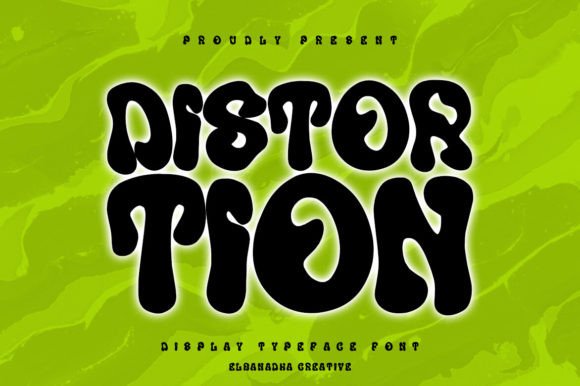
Distortion is a display font with a light, playful rhythm—rounded terminals, subtle asymmetry, and just enough irregularity to feel handmade without sacrificing clarity. It’s not a script, not a serif, not a geometric sans—it lives somewhere between a friendly doodle and a carefully composed logo. There’s warmth in its curves, curiosity in its angles, and an unmistakable sense of ease. It doesn’t demand attention; it earns it by making readers pause, soften their shoulders, and lean in just a little.
I set the ebook title in Distortion at 48pt on a cream background, with a thin serif (a gentle Garamond variant) for the subtitle and body text. Instantly, the layout exhaled. The font didn’t compete with the photography—it framed it, like a hand-drawn border around a cherished memory. That’s Distortion’s quiet strength: it enhances intention without overwhelming it.
In editorial design, where tone and trust are built in milliseconds, a display font like Distortion becomes more than decoration—it’s emotional punctuation. I’ve used it for chapter openers in a digital magazine feature on slow living, where each section began with a single word in Distortion, centered above ample white space. Readers told me those openings “felt like taking a breath.” In a printable wedding guide, it anchored the “Vows & Values” section header—not overly romantic, not clichéd, but tender and sincere. And for a coaching workbook’s reflection prompts, Distortion softened the directive tone of questions like “What feels true right now?”—making them feel like invitations, not assignments.
It shines most naturally in titles, cover text, pull quotes, and short accent phrases—anywhere you want to signal warmth, approachability, or thoughtful whimsy. It’s not designed for long paragraphs or dense captions, and that’s by thoughtful design, not limitation. Its charm lies in contrast: when paired with a highly legible serif for body copy or a clean, open sans serif for navigation and notes, Distortion creates visual hierarchy that feels intuitive, not engineered. Think of it as the voice that introduces the story—the rest flows from there.
On screen, Distortion holds up beautifully at larger sizes across devices. I tested it in a newsletter header viewed on mobile, tablet, and desktop—and even at 36pt on a small OLED screen, its letterforms retained their character without blurring or pixelation. For PDF exports (like the recipe ebook or planner templates), it embeds cleanly, preserving spacing and weight. In print, especially on uncoated or textured paper, its slight imperfections become assets—echoing the tactility of ink on fiber, reinforcing a human-centered aesthetic.
What surprised me most was how consistently it supported brand identity—not by shouting “look at me,” but by quietly reinforcing a feeling. A lifestyle blog redesign using Distortion for post titles and category badges didn’t just look prettier; it felt more cohesive, more aligned with the writer’s calm, reflective voice. Readers didn’t comment on the font—but they did say the site “felt like coming home.” That’s the mark of thoughtful typography: it works so well you forget it’s working at all.
Before adding Distortion to your next project, take a moment to explore what’s included. Check for alternate characters—some versions offer charming ligatures or stylistic sets that add nuance to repeated words. Look for weight options: while Distortion is typically offered in a single, expressive weight, some variants include light or bold alternates for layered emphasis. If your project serves multilingual audiences, verify language support—especially for accented characters common in European languages or extended Latin sets. And always confirm licensing: Distortion is a commercial font, meaning it’s fully cleared for use in client work, paid newsletters, digital downloads, printables sold on marketplaces, and ebook covers—no hidden restrictions, no surprises.
Pairing Distortion thoughtfully deepens its impact. With serif body fonts—think Caslon, Adobe Text, or a warm Didot—it gains elegance and gravitas. With airy sans serifs like Inter, Poppins, or Lato, it feels modern and grounded. Even against a restrained monospace for code snippets or timestamps, Distortion adds a welcome pulse of personality. What matters isn’t strict contrast, but complementary intention: if Distortion says “pause and wonder,” your supporting type should say “read on, comfortably.”
There’s a quiet confidence in choosing a display font that doesn’t chase trends—that instead asks, gently, what feeling this piece of content wants to carry. Distortion doesn’t solve every typographic challenge, and it shouldn’t. But in the right place—in a wedding invitation suite, a mindfulness course PDF, a seasonal newsletter graphic, a printed planner’s monthly overview—it does something rare: it makes space for joy without demanding it.
Typography, at its best, is empathy made visible. Distortion reminds us that even the smallest design choices—a curve, a tilt, a pause between letters—can echo the care we want readers to feel. It won’t fix weak writing or unclear structure. But it will honor both, with warmth, wit, and unwavering charm.