Rear Window: A Spooky Display Font for Halloween Crafters
There’s that moment—mid-October, coffee in hand, editing a candle label mockup—when you realize the font isn’t *quite* right. You’ve tried three clean sans serifs and two elegant scripts, but none carry the whisper of fog on a graveyard path or the creak of an old porch swing at dusk. That’s when I opened Rear Window. Instantly, the mood shifted. Not just “Halloween-y,” but authentically atmospheric—like something pulled from a vintage horror poster or a candlelit séance invitation.
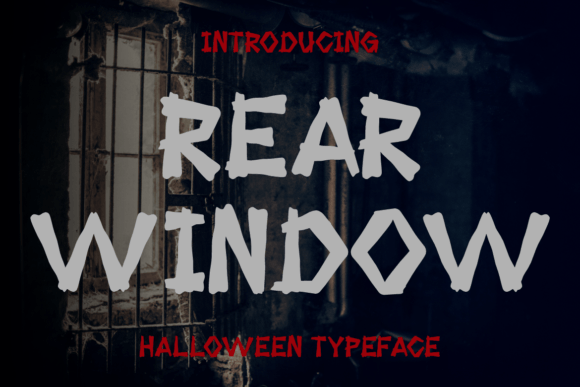
Rear Window is a display font built for impact, not paragraphs. Its tall, slightly uneven capitals lean with quiet drama; subtle tapering strokes and delicate terminals suggest movement—like smoke curling upward or a shadow stretching across cobblestone. It’s not cartoonish or over-the-top. Instead, it leans into mystery: restrained yet evocative, decorative but never fussy. That balance is why it works so well for handmade goods—it adds personality without overwhelming craft integrity.
I first tested Rear Window on soy wax candle labels—“Midnight Bramble” and “Witch’s Thyme”—printed on kraft sticker paper. The font held up beautifully at 24–36 pt sizes: crisp edges for clean cutting on my Cricut, enough contrast to read instantly on shelf displays, and just enough irregularity to feel handmade, not mass-produced. Because it’s a display font, I kept it strictly for product names and short descriptors—never body text—and paired it with a warm, neutral sans serif (like Montserrat Light) for ingredients and safety notes. That pairing gave the label hierarchy, warmth, and professionalism—exactly what customers notice before they even smell the scent.
It shines just as brightly on printable wall art. I designed a set of three 8×10 digital downloads—“Ghosts Don’t Pay Rent,” “Beware the Moon,” and “Coven Hours Only”—using Rear Window for titles only, then layered soft watercolor textures behind. The font’s vertical rhythm made each phrase feel like a whispered incantation, while its generous letter spacing prevented visual crowding on screen or when printed at home. For physical stickers and boutique tags, I stuck to bold, centered phrases (“Pumpkin Spice & Everything Nice”) at 28–40 pt—large enough for die-cut clarity, small enough to fit on mini apothecary jars or gift box seals.
What surprised me most was how well Rear Window translated to fabric and ceramics. On a black cotton tote bag, heat-pressed with a simplified vector version (converted carefully in Illustrator), the font retained its moody elegance—no pixelation, no awkward joins. Same with ceramic mugs: the clean outlines meant smooth sublimation transfer, and the slight asymmetry added charm rather than confusion. For wedding stationery—yes, even spooky-chic autumn weddings—I used it sparingly: only on welcome signs and cocktail napkin monograms. Paired with a gentle script for names and a sturdy serif for details, it created contrast that felt intentional, not chaotic.
Readability matters—especially when your audience is scrolling Etsy listings on phones or squinting at a farmers’ market table. Rear Window reads best at 20 pt and up. Below that, fine details blur. For small stickers (under 1.5 inches wide), I avoided full words—opting instead for single glyphs like “🎃”, “🕯️”, or stylized initials—then anchored them with Rear Window’s bold “O” or “W” as decorative accents. Always test cut first: check kerning between letters like “AV” or “RT”—some display fonts tighten those pairs too aggressively for vinyl weeding.
Before using Rear Window commercially, I double-checked the license. It includes OTF and WOFF files, basic Latin character support (perfect for English greetings, shop names, and seasonal phrases), and clear commercial rights for physical products, digital downloads, and limited-edition merchandise. No extended license needed for printables or SVG bundles—as long as I’m not reselling the font file itself. I also scanned the stylistic alternates: a few swashed “S” and “E” options added subtle flair to greeting card headers without sacrificing legibility.
Font pairing is where Rear Window truly sings. Think of it as the dramatic lead actor—always supported by a grounded co-star. A friendly handwritten font (like “Dancing Script”) softens its intensity for birthday invitations with a haunted twist. A sturdy geometric sans (like “Inter”) balances its romance for packaging labels. Even a classic serif like “Cormorant Garamond” creates elegant tension on wedding welcome boards—where “Rear Window” announces the event, and the serif handles names and times with quiet authority.
It’s not for everything—and that’s its strength. You wouldn’t set a full recipe booklet or a multi-page planner in Rear Window. But for titles, tags, signage, social media banners, and any place you want to evoke nostalgia, suspense, or seasonal magic? It delivers. Whether you’re designing digital planner pages with “October Reflections” headers, laser-cut wooden signs for a pop-up shop, or foil-stamped greeting cards that feel like heirlooms—it deepens the story your product tells before a single word is read.
What makes Rear Window especially valuable for makers is how it bridges aesthetic and function. It doesn’t just look like Halloween—it feels like the *spirit* of it: thoughtful, atmospheric, quietly confident. When your candle label stops a scroll, when your printable gets pinned three times in an hour, when a customer snaps a photo of your mug because “the font is *so* them”—that’s Rear Window doing quiet, creative work. Not shouting. Just lingering, like mist at twilight.