Varsity Tokyo: A Bold, Wintry Display Font That Delivers
I opened a fresh brand board last week for a small-batch maple syrup producer—think hand-poured bottles, kraft labels, and seasonal farmers’ market presence. The brief called for warmth, heritage, and a quiet nod to winter without leaning into cliché snowflakes or candy cane stripes. I scrolled past three “rustic serif” options, paused on a script that felt too delicate for shelf impact, then landed on Varsity Tokyo. Not as a last resort—but because its name alone suggested something crisp, intentional, and just slightly unexpected.
A Typeface with Texture and Temperature
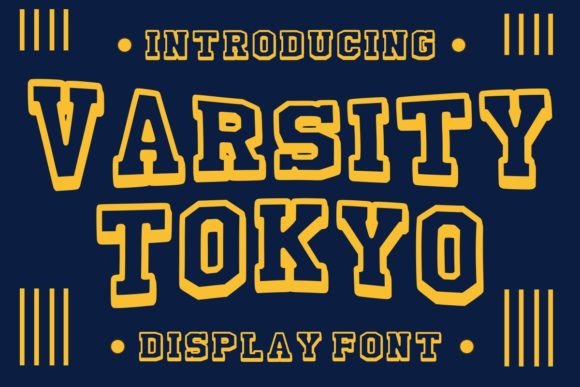
Varsity Tokyo is a display font—not a workhorse, not a paragraph partner, but a statement-maker. It’s built on clean, confident lines: sharp angles, tight counters, and a bold weight that holds its ground even at small sizes on packaging or tags. There’s no frill, no shadow, no faux-3D effect—just strong, unapologetic letterforms with subtle geometric discipline. It feels wintry not because it’s icy, but because it’s precise, grounded, and quietly energetic—like frost patterns on glass or the crisp edge of freshly packed snow.
It’s not “festive” in the tinsel-and-bells sense. It’s more winter-ready: the kind of typeface you’d trust on a wool sweater tag, a limited-edition candle label, or a café chalkboard sign announcing “Hot Spiced Cider, Back Today.” That line-based construction gives it rhythm and clarity—no optical blur, no visual fatigue—even when set tightly in all-caps headlines or stacked on a poster.
Where It Shines (and Where It Steps Back)
I tested Varsity Tokyo across six real touchpoints: a logo lockup (paired with a neutral sans for balance), a 4-color product label, a website hero banner, Instagram story text overlays, business cards printed on textured stock, and a double-sided A5 flyer for a holiday pop-up. In every case, it performed like a seasoned collaborator—not demanding attention, but commanding respect when it mattered.
On the syrup label? Perfect. The bold weight held up against natural wood grain backgrounds and didn’t compete with hand-drawn illustrations. On the website header? It anchored the layout without needing extra spacing or tracking adjustments—unusual for a display font at that scale. And on the business card? Even at 10 pt for a tagline (“Small Batch • Big Flavor”), it remained legible and characterful—though I wouldn’t push it below 8 pt for print.
Where it stepped back was predictable—and honest: body copy, long captions, multi-line email headers, or anything requiring sustained reading. It’s not designed for that. And while it adds instant personality to a boutique skincare brand’s gift box, it wouldn’t suit a law firm’s annual report or a university’s academic brochure. That’s not a flaw—it’s fidelity to its role as a display font.
Pairing It Without Overthinking
Varsity Tokyo doesn’t need drama to shine. In fact, its strength lies in contrast: pair it with something soft, simple, or human-scaled. I landed on two reliable combinations:
- A warm, open sans serif (like Poppins Light or Inter Regular) for subheads, body text, and UI labels—clean enough to let Varsity Tokyo breathe, friendly enough to keep tone approachable.
- A low-contrast serif (think Lora or Literata) for editorial touches—ingredient lists, story blurbs, or quote callouts—where you want warmth and tradition without competing with the display font’s energy.
I avoided pairing it with other display fonts or heavy scripts—too much personality in one space creates visual noise. And while it *can* sit beside a restrained handwritten accent (e.g., for a “hand-stirred” note on packaging), I kept those uses minimal and purpose-driven—not decorative.
Practical Notes Before You Commit
Varsity Tokyo ships as a single bold weight—no light, medium, or italic variants. That’s fine if you’re using it strictly for headlines, logos, and short phrases (which is exactly what it’s built for). But don’t expect flexibility for typographic hierarchy within a single block of text. It includes standard Latin characters and basic punctuation—sufficient for English branding, but verify multilingual support if your audience spans beyond that.
File formats are straightforward: OTF and WOFF2 included, so it works cleanly in design apps and modern web builds. No ligatures or swashes—just clean, functional forms. That simplicity is part of its reliability.
One non-negotiable: always check the commercial font license before using Varsity Tokyo in client work. Whether it’s for a bakery’s sticker sheet, a podcast’s social banner, or a Shopify store’s homepage—it needs proper licensing for distribution, resale, or embedded use. Most reputable sellers clarify this clearly; when in doubt, read the EULA—not the product title.
Final Thought—Not a Trend, but a Tool
Varsity Tokyo won’t solve every branding challenge. It won’t make weak concepts compelling or replace thoughtful strategy. But as a premium font built for clarity, seasonality, and shelf presence—it delivers. It’s the kind of typeface that makes clients say, “Yes—that feels like *us*,” not because it’s flashy, but because it’s resolved, intentional, and quietly confident. If your project calls for warmth with structure, winter with wit, or boldness with restraint—this display font earns its place on the board.