Guroba: A Bold, All-Caps Display Font for Logos That Land
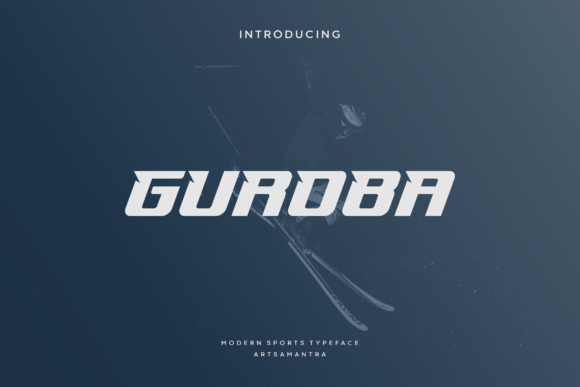
It was 10:47 a.m., third coffee, and I’d just opened a blank brand board for a local ceramicist’s rebrand—hand-thrown mugs, earthy glazes, quiet confidence. The logo concept was clean but needed a spark: something that felt grounded yet forward-moving. I typed “Guroba” into my font menu, hit all-caps, and dropped it onto the draft. Instantly, the composition tightened. Not because it was loud—but because it had *direction*. That’s Guroba in a nutshell: a modern letter cutout with a dynamic slant that pulls your eye like a sprinter leaning into the curve.
What Guroba Actually Looks Like—No Hype, Just Observation
Guroba isn’t subtle. It’s all-caps only, built for impact—not explanation. Each letter has a crisp, geometric cutout quality: think precision laser-cut metal or a sharp stencil edge, softened just enough by its consistent forward tilt. That slant isn’t decorative—it’s functional. It creates motion without chaos, futurism without coldness, sportiness without cliché. There’s no rounded friendliness here, no handwritten warmth—but there *is* energy, clarity, and a kind of confident minimalism. It doesn’t try to be everything; it knows exactly what it is: a display font, first and foremost.
Where It Shines (and Where It Steps Back)
I tested Guroba across six real touchpoints: the logo lockup, a brand board header, matte-finish ceramic packaging labels, a folded business card, a website hero banner, and Instagram story banners. Here’s what held up:
- Logo design: Outstanding. On the ceramicist’s mark—just her initials “AC”—Guroba gave instant memorability. The slant made it feel intentional, not arbitrary. No kerning tweaks needed; spacing felt balanced out of the box.
- Packaging labels: Printed at 14pt on uncoated kraft paper? Still legible and striking. The cutout effect translated well to tactile surfaces—no ink bleed, no loss of definition.
- Website headers & social banners: Scaled cleanly up to 96pt on desktop and remained bold and readable at 36pt on mobile. Its strong silhouette holds up even with low-contrast backgrounds (e.g., charcoal text on warm beige).
- Business cards: Worked best as a single-line element—logo or monogram. Tried stacking two lines (“ARTISAN CERAMICS”) and found the slant amplified visual weight, making the second line feel slightly heavier. Best used sparingly, intentionally.
Where it didn’t fit? Body copy—obviously. But also formal stationery (think law firm letterhead), long-form editorial layouts, or any context demanding neutrality or timelessness. Guroba announces itself. It’s not background music—it’s the opening guitar riff.
Pairing It Without Overcomplicating Things
Guroba doesn’t need a partner—but it benefits from one. I paired it with IBM Plex Sans (a neutral, open-source sans) for body text and captions. The contrast worked because Plex provided calm structure while Guroba delivered voice. For a warmer alternative, a restrained serif like Freight Text added quiet authority without competing. Avoid pairing it with other high-contrast display fonts or scripts—the energy clashes. And skip anything with a competing slant; Guroba’s angle is part of its identity, not a trend to echo.
Practical Notes Before You Commit
Guroba ships as a single-weight, all-caps display font. No italics, no light or bold variants—just one confident voice. That’s fine, honestly. Its strength lies in focus, not flexibility. It includes standard Latin characters and basic punctuation. No extended multilingual support or OpenType features like ligatures or swashes—so if your project needs Cyrillic, Vietnamese, or stylistic alternates, look elsewhere. File formats are standard (.otf, .woff2), and webfont licensing is included, but always double-check the license before using it in client work—especially for merchandise, templates, or print-on-demand products. It’s a commercial font, yes, but not a “one-license-fits-all” solution.
One last note: test it early, and test it *big*. Guroba doesn’t whisper at 12pt. Try it at 48pt minimum on your brand board—even better, mock it up on a physical product label or shop sign preview. See how it behaves in context, not just in isolation. Does it feel like *that brand*, or just “cool typography”? With Guroba, the answer should be immediate—and specific.
If you’re building a brand that values motion, modernity, and visual punch—especially for logos, packaging, signage, or digital headers—Guroba earns its place. It’s not versatile in the Swiss-army-knife sense. But as a display font with personality, precision, and presence? It delivers—cleanly, confidently, and without compromise.