Joyish: A Display Font That Earns Its Smile
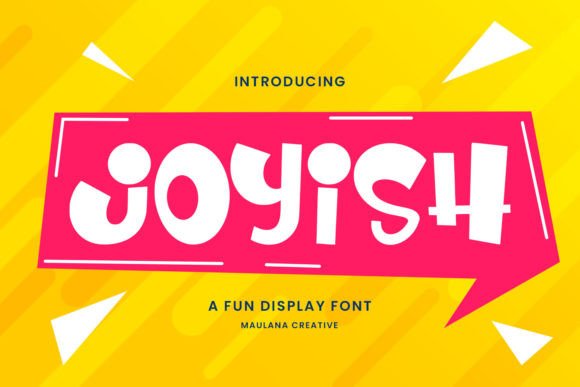
As a designer who’s tested over 200 display fonts in real client work—from artisanal jam labels to SaaS landing pages—I opened Joyish expecting charm. What I got was something rarer: intentionality wrapped in warmth. Joyish doesn’t shout “fun.” It leans in, tilts its head slightly, and invites trust before the first word is read. Its curves are generous but controlled; its terminals are softly tapered, not blunt or exaggerated. There’s no forced quirk—no wobbly baseline, no distracting ligatures—and that’s exactly why it works so well in professional contexts.
First Impressions Aren’t Just Visual—They’re Emotional Anchors
Joyish feels handmade without looking hand-drawn. The lowercase a, e, and g carry subtle open counters and gentle stress shifts—details that whisper craftsmanship, not algorithmic whimsy. Uppercase letters hold confident proportions: tall x-height, modest ascenders, and a rhythm that breathes across a line. It’s friendly but never cutesy, modern but not sterile. That balance makes Joyish an immediate candidate for brands building approachability *without* sacrificing authority—think boutique wellness studios, indie publishers, ceramic studios, or sustainable skincare lines.
Where Joyish Shines (and Where It Steps Back)
This is a display font—not a workhorse. It thrives where attention is earned, not demanded. In logo design, Joyish delivers instant recognition with minimal elements: a single-word mark like “Haven” or “Lume” locks in memorability fast. For packaging design, it lifts matte-finish soy ink labels into premium territory—especially when paired with a crisp sans serif for ingredients or certifications. On product labels, it performs best at 18–36 pt: legible at arm’s length, expressive up close.
In social media graphics, Joyish punches above its weight. A quote overlay on an Instagram carousel? Perfect. A limited-edition drop announcement for a digital product? Strong. But don’t force it into body copy—even at 14 pt, readability frays. Joyish isn’t built for paragraphs. It’s built for moments: a headline above a newsletter signup, a bold pull quote in editorial design, a foil-stamped title on a wedding invitation, or a centered phrase on a tote bag.
For merchandise and Cricut projects, its clean vector outlines scale beautifully. No hairline gaps, no fragile serifs to break during vinyl cutting. And yes—it holds up in black-and-white print: no greying, no loss of contrast. That matters for printable design like planners or greeting cards where color isn’t guaranteed.
What Happens When You Use Joyish in Context
Readability isn’t just about letterforms—it’s about hierarchy, pacing, and psychological weight. Joyish creates natural visual hierarchy by default: its presence signals “this is the idea you’re meant to feel first.” That helps audiences parse content faster, especially in crowded feeds or retail environments. In brand identity systems, it builds consistency not through repetition, but through emotional resonance—every use reinforces the same tone: grounded, human, quietly confident.
Audience trust rises when typography feels considered—not trendy. Joyish avoids the fatigue of overused script fonts or the coldness of ultra-thin sans serifs. It says, “We made this with care,” which translates directly to perceived value. That’s critical for small business owners and digital sellers competing on authenticity, not just price.
Font Pairing: Less Is More (But Choose Wisely)
Joyish pairs cleanly—but only with typefaces that respect its personality. Next to a sturdy serif font like Merriweather or EB Garamond, it gains gravitas. Beside a neutral sans serif font like Inter or Poppins, it gains clarity. Avoid pairing it with other display fonts unless there’s strong contrast in weight, proportion, or mood—two display fonts in one layout often cancel each other out.
Don’t pair Joyish with a busy script font or handwritten font. Their energy competes. Instead, let Joyish be the voice, and use a quiet sans serif for supporting text. In web design, test loading performance: Joyish renders cleanly across devices, but always serve it as a variable font if available—or subset characters for faster load times on marketing pages.
Practical Designer Notes You’ll Actually Use
- Test it in black and white first. Joyish’s charm isn’t dependent on color—it’s in structure. If it reads well without hue, it’ll hold up everywhere.
- Check small-size readability at 14 pt on screen and 10 pt in print. It softens below that. Reserve it for headlines, quotes, and marks—not captions or footnotes.
- Try it on real mockups—not just type specimens. Drop it onto a coffee bag mockup, a Shopify banner, or a Canva Instagram post. Context reveals what specs hide.
- Compare uppercase vs. lowercase settings. Joyish’s all-caps setting tightens spacing intentionally—great for short brand marks. Lowercase flows more conversationally for subheads or quotes.
- Review kerning pairs manually. Letters like “To”, “Wa”, and “Fr” benefit from slight adjustments in tight layouts—especially for logos.
- Confirm commercial licensing before client use. Joyish is a commercial font, but verify usage rights for extended licenses (e.g., embedding in apps or selling templates).
Final Judgment: Not Just Another Creative Font
Joyish earns its place in my core design assets folder—not because it’s novel, but because it’s reliable. It solves real problems: how to signal warmth without cliché, how to stand out without shouting, how to feel personal without looking amateur. It’s a premium font that behaves like a team member: consistent, adaptable, and quietly brilliant.
If you’re choosing a display font for brand identity, packaging design, or social media graphics, ask yourself: does it support the message—or distract from it? Joyish supports. It elevates. And most importantly, it lets the work—not the typeface—take center stage.