Kaiseng: A Standout Display Font for Digital Branding
There it was—my third revision of the hero section for a boutique coaching site—and something still felt off. The headline had clarity, but no spark. I swapped in Kaiseng on a whim, set it at 48px on desktop and watched how it settled over a soft gradient background. Instantly, the page exhaled. Not flashy, not forced—just confident, warm, and unmistakably human. That’s when I knew: Kaiseng isn’t just another display font. It’s a quiet confidence-builder for digital spaces that need personality without pretension.
What Makes Kaiseng Feel So Intentionally Human
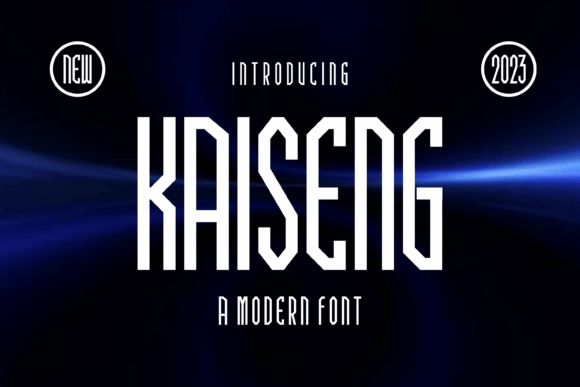
Kaiseng lives firmly in the display font category—but it avoids the common pitfalls of overly ornate or brittle display typefaces. Its letterforms balance subtle contrast with generous open counters, giving it breathing room even at smaller sizes. There’s a gentle rhythm to the curves—especially in letters like a, e, and s—that feels hand-informed but digitally refined. It’s not a script font, nor a handwritten font, yet carries that same approachable sincerity. Think of it as modern typography with soul: clean enough for a premium brand, expressive enough to hold attention on a crowded landing page.
How It Performs in Real Web Layouts
I tested Kaiseng across several contexts: a portfolio homepage header, a course sales page CTA button, a blog post title with image overlay, and a responsive navigation bar (as a logo lockup only). On desktop, it shines in hero sections—especially when paired with generous line height and subtle letter spacing. At 36–60px, its details resolve beautifully, and the weight holds up against bold photography or textured backgrounds.
On mobile? It stays legible down to ~28px—provided you avoid tight tracking or stacking multiple lines too closely. I used it for a sticky header logo on a small business site and found it scaled cleanly using font-display: swap and WOFF2 delivery. No flicker, no layout shift. For buttons, I reserved it strictly for primary CTAs (like “Start Your Journey” or “Get the Guide”)—never for secondary actions or form fields—because its charm lies in emphasis, not utility.
Where Kaiseng Adds Real Value—And Where to Pause
Kaiseng elevates moments that ask users to *feel* before they act: welcome messages, value proposition headers, testimonial quotes, and campaign banners. On a product landing page, it gave the headline “Design With Purpose” unexpected warmth—making the offer feel personal, not transactional. In a digital brand kit preview, it anchored color and tone faster than any mood board could.
That said, Kaiseng isn’t built for long-form reading. I tried it for an article subhead followed by dense body copy—immediately regretted it. Its character is too distinct to recede. Likewise, skip it for navigation labels, form inputs, table headers, or anything requiring quick scanning or accessibility-first clarity. It’s not a web-safe font replacement; it’s a strategic accent. And while it handles English beautifully, I double-checked multilingual support before using it on a bilingual client site—good news: extended Latin characters are included, but Cyrillic or Asian language coverage isn’t part of the base package.
Smart Pairings That Let Kaiseng Shine
Kaiseng thrives when paired with intention—not contrast for contrast’s sake. My go-to pairing is a neutral, highly legible sans serif like Inter, Manrope, or even system fonts (San Francisco, Segoe UI) for all body, caption, and interface text. The juxtaposition works because Kaiseng brings voice; the sans brings function. For more editorial sites—a writer’s portfolio or creative agency—I’ve layered it over a restrained serif like Cormorant Garamond for section titles, letting Kaiseng handle the emotional hook and the serif carry narrative weight.
One pro tip: if your project includes alternate glyphs or swashes (Kaiseng offers a few elegant ligatures), use them sparingly—only where visual pause matters most, like the first word of a hero statement or a key word in a testimonial pull quote. Overuse dilutes impact.
Practical Notes Before You Implement
Before dropping Kaiseng into a live site or client project, verify three things: First, confirm the license covers commercial web use—including embedded fonts in SaaS dashboards or online courses. Second, check file formats: WOFF2 is essential for performance; TTF alone won’t cut it for modern loading standards. Third, review what’s included—does it come with bold/regular weights? Are there italic variants or stylistic sets? In my case, the single-weight version was perfect for headlines, but I’d want a lighter or bolder option for layered hierarchy in complex layouts.
Also worth noting: Kaiseng renders consistently across Chrome, Safari, and Firefox—but I always test on iOS Safari, where some decorative fonts can appear slightly tighter. A quick 5-minute check saved me from a last-minute tracking adjustment post-launch.
At its core, Kaiseng reminds me why I love typography: it’s not about decoration—it’s about resonance. When the right display font meets the right moment, it doesn’t just say something. It makes people *stop*, *breathe*, and *belong*. That’s rare. And that’s why, these days, I reach for Kaiseng first—not for every headline, but for the ones that truly matter.