Midnight Danger: A Display Font That Sets the Tone
It was a quiet Tuesday afternoon—coffee still warm, laptop open, and a half-finished layout for a seasonal newsletter staring back at me. I’d just launched a new series of printable wellness guides, each themed around moon phases and mindful routines. The content felt grounded, intentional, even gentle—but the header font? It didn’t whisper calm. It shouted generic.
That’s when I reached for Midnight Danger.
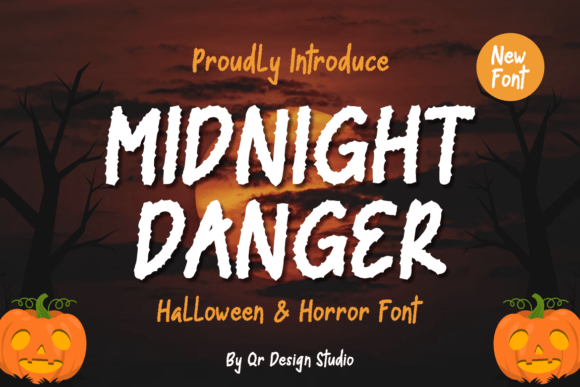
At first glance, it sounds like something you’d find in a gothic novel or a vintage horror poster—and it is, beautifully so. But what surprised me wasn’t its spookiness; it was how effortlessly it settled into editorial work that needed presence without pretension. Midnight Danger is a display font, yes—but not one that performs for attention alone. It carries rhythm, intention, and a subtle narrative weight. Its letterforms are slightly condensed, with sharp serifs, delicate terminals, and a quiet asymmetry that feels hand-carved rather than algorithmically generated. There’s tension in the contrast—thick strokes that anchor, thin ones that lift—and yet, it never feels aggressive. It feels considered.
I used it for the cover title of a digital magazine feature on slow living in urban spaces. Not as a headline screaming for clicks, but as an invitation—evocative, atmospheric, quietly confident. Readers told me later they paused before scrolling. That pause? That’s where editorial resonance begins.
Midnight Danger shines most when it’s given space to breathe: blog headers, ebook covers, chapter openers, pull quotes, and printable planner covers. It’s not built for long paragraphs or body copy—that’s not its role. It’s a conductor, not the orchestra. In my coaching workbook project, I paired it with a warm, highly readable serif for body text and a light sans serif for captions and callouts. The result? Immediate hierarchy. Instant mood. Zero visual noise.
What makes it especially useful across formats is its thoughtful construction. The included OpenType features—ligatures, stylistic alternates, and carefully balanced punctuation—add nuance without complexity. I toggled a few alternates for the word “Night” in a wedding guide’s chapter divider, and suddenly, the typography felt personal, almost ceremonial. No extra plugins. No design gymnastics. Just quiet precision.
On screen, it holds up well at larger sizes—especially in modern browsers and PDF exports. For mobile layouts, I keep it reserved for hero graphics or email headers (always paired with web-safe fallbacks in CSS), never for small interface labels or navigation. In print, it gains even more character: rich ink coverage, crisp edges, and a tactile sense of craft. I’ve used it in a limited-run recipe ebook printed on uncoated stock—and the texture of the paper played beautifully against its sharp, elegant forms.
Its editorial appeal lies in how it supports voice. A lifestyle blog exploring quiet rituals doesn’t need flashy energy—it needs authenticity, texture, and continuity. Midnight Danger delivers that. So does a digital magazine covering folklore and regional storytelling. Or a printable planner designed for reflection rather than productivity. It doesn’t shout “look at me”—it says, “this matters.” And in an age of visual oversaturation, that kind of restraint is rare.
Pairing is intuitive. With serif body fonts—think Garamond, Merriweather, or a custom text face—it adds gravitas and timelessness. With clean sans serifs like Inter, Lato, or Source Sans Pro, it creates a compelling contrast between warmth and clarity. I avoid pairing it with other display fonts or scripts unless there’s strong conceptual alignment—say, a handwritten subtitle for a storytelling workshop, where both fonts share a handmade sensibility. Even then, I limit it to one accent per spread.
Licensing is straightforward: it’s a commercial font, fully cleared for use in client work, digital downloads, ebooks, newsletters, and printables—as long as you’ve purchased the appropriate license. Before embedding in a course PDF or bundling into a Canva template, I always double-check the license terms for redistribution rights. It ships in standard formats (.otf, .ttf) and includes full Latin character support, with thoughtful punctuation and spacing for English-language editorial use.
In practice, I’ve seen Midnight Danger elevate projects where tone is as important as content: a newsletter header that signals depth before the first sentence; a chapter title that lingers in memory; a printable guide cover that invites slow, tactile engagement. It works because it doesn’t try to do everything—it does one thing exceptionally well: give weight to meaning.
Typography, at its best, isn’t decoration. It’s stewardship—of voice, of pace, of attention. Midnight Danger reminds me that choosing a display font isn’t about trend or novelty. It’s about finding the right vessel for what you want your readers to feel before they even begin reading. And sometimes, the most powerful statement is made not in boldness, but in atmosphere—in the hush just before midnight, when everything slows, and the story begins.
- Best for: Blog headers, ebook titles, newsletter graphics, chapter openers, pull quotes, printable covers, editorial feature pages
- Avoid for: Body text, UI labels, dense tables, mobile navigation, long-form web articles
- Pair well with: Highly readable serif fonts (for body), neutral sans serifs (for captions), or minimalist monospaced fonts (for subtle contrast)
- Check before use: License scope for digital distribution, file format compatibility with your workflow (e.g., Figma, Adobe apps, Canva), and multilingual needs beyond basic Latin