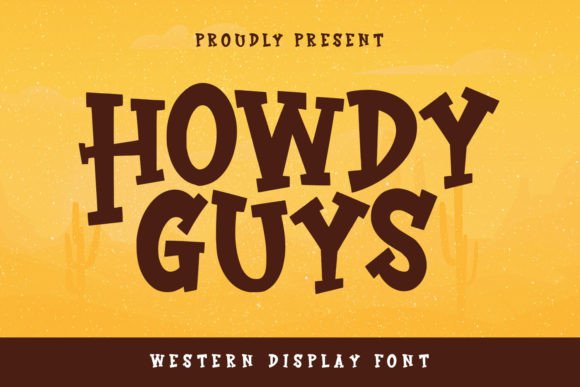
Howdy Guys: A Warm, Quirky Display Font for Digital Branding
There I was—midway through designing the hero section of a new coaching website—when I paused to test Howdy Guys. The client wanted “approachable but memorable,” something that felt human, grounded, and just a little playful. I’d already tried three clean sans serifs and two elegant serifs—but none carried that effortless charm. Then I dropped Howdy Guys into the headline: “You’ve Got This.” Instantly, the whole layout softened and smiled. Not in a cartoonish way—just warm, intentional, and unmistakably human.
What Makes Howdy Guys Stand Out on Screen
Howdy Guys is a display font with Western roots and modern versatility. It’s not a literal cowboy typeface—no exaggerated spurs or dusty serifs—but it carries that same spirit: friendly, confident, and quietly confident. The letterforms have gentle irregularities—slight variations in stroke weight, subtle asymmetry in curves, and a relaxed rhythm that avoids robotic precision. That’s what makes it feel hand-crafted, even at scale. On a high-resolution screen, it holds its personality without pixelation; in a responsive layout, it scales cleanly from desktop headlines down to tablet-sized banners.
Real-World Web Uses That Shine
I tested Howdy Guys across several digital contexts—and it consistently elevated tone without sacrificing clarity:
- Landing page headlines: Paired with Inter UI (a clean, neutral sans serif), Howdy Guys created instant visual hierarchy on a course sales page—readers scanned the headline first, then flowed naturally into body copy.
- Hero section overlays: Over a softly blurred lifestyle photo, Howdy Guys remained legible even at 48px on mobile—its open counters and generous x-height kept characters distinct against texture.
- CTA buttons: At 24px on desktop and 20px on mobile, it worked beautifully for primary action buttons (“Start Your Journey”, “Grab Your Spot”). Its rounded terminals softened sharp corners, making CTAs feel inviting—not urgent.
- Section dividers & subheads: Used sparingly as H3s in a portfolio site, it added character without overwhelming—especially when set in all caps with tight letter-spacing for impact.
- Digital brand kits: Included in a downloadable brand guide, Howdy Guys served as the “personality anchor”—the one font clients immediately associated with voice and warmth.
Readability & Responsiveness: What Works (and What Doesn’t)
Like any strong display font, Howdy Guys thrives where attention is earned—not demanded. It’s highly legible at sizes 24px and up on light backgrounds, and remains clear at 32px+ over subtle image overlays. I tested it on iOS Safari, Chrome, and Firefox—no rendering hiccups, no unexpected kerning shifts. On dark mode previews, it held contrast well when paired with a light off-white (#f9f9f7) rather than pure white.
That said, it’s not built for dense interface work. I tried it for navigation labels and form placeholders—it lost clarity fast below 18px. Small mobile menu items? Too decorative. Form field hints? Too expressive. And while it’s lovely in short bursts, Howdy Guys isn’t meant for paragraphs, blog intros, or long-form content blocks. Its strength lies in framing—not filling.
Smart Pairings for Balanced Digital Typography
The magic of Howdy Guys really unfolds in pairing. It needs breathing room—and a grounded partner. In every project I used it, I paired it with a versatile, highly readable sans serif: Inter, Manrope, or even system fonts like -apple-system for fallback reliability. For more editorial sites (like a creative blog or storytelling portfolio), I experimented with a quiet serif—Lora or Cormorant Garamond—for body text. The contrast was striking: Howdy Guys brought voice; the serif brought rhythm and rest.
One note on scripts: avoid pairing Howdy Guys with overly ornate or tightly spaced script fonts—they compete for attention. A light, airy handwritten font (like Quicksand or Caveat at low weight) can complement it for accent quotes or signature lines—but only if used once per page.
Practical Considerations Before You Deploy
Before adding Howdy Guys to your next live site, check a few key things:
- Webfont formats: Confirm it includes WOFF2 (for modern browsers) and WOFF (for broader support). Some display fonts skip WOFF2, which impacts load speed.
- Weights & styles: Most versions include Regular and Bold—enough for headers and emphasis. If you need italics or condensed variants, verify they’re included.
- Licensing: Ensure your license covers commercial web use—especially if embedding via @font-face on client sites or SaaS dashboards.
- Character set: Test key accented characters if your audience uses diacritics (e.g., café, naïve, résumé). Not all display fonts include extended Latin support.
- Load strategy: Since it’s a display font, consider loading it asynchronously or using font-display: swap to avoid invisible text during render.
At its best, Howdy Guys doesn’t just say something—it makes people feel something before they read a word. That’s rare. And valuable. Whether you’re refining a boutique online store, launching a course, or building a personal brand site, this font gives digital space a dose of sincerity—without sacrificing polish.