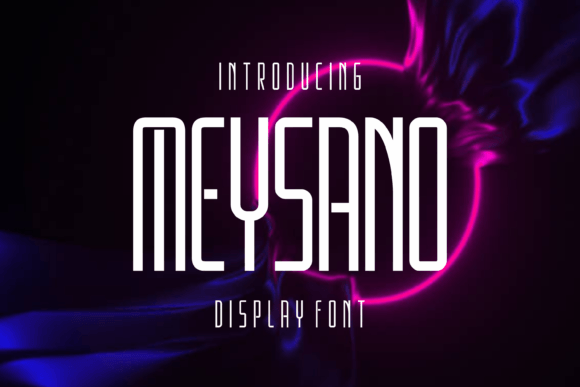
Meysano: A Display Font That Adds Personality Without Sacrificing Clarity
Last week, I was finalizing the hero section for a new landing page—a small-batch ceramic studio’s online shop—and found myself scrolling through dozens of display fonts. Most felt either too rigid or too chaotic. Then I loaded Meysano. Within seconds, it clicked: this isn’t just decorative—it’s expressive, intentional, and surprisingly legible at scale.
Meysano is a modern display font with subtle quirks: slightly uneven stroke contrast, gentle asymmetry in letterforms like the lowercase a and g, and a warmth that avoids feeling sterile or overly playful. It’s not a script or handwritten font—but it carries that human touch. Think of it as the typographic equivalent of hand-thrown pottery: precise enough to feel considered, but never machine-perfect. That makes it ideal for brands that want to stand out without shouting.
I tested Meysano across several real layout contexts. First, over a soft-focus product image in the hero banner—set at 48px on desktop, 36px on tablet, and 28px on mobile. Even at smaller sizes, its open counters and generous x-height kept it readable. On dark mode (a charcoal background), I bumped the weight slightly and added subtle letter-spacing—no halo effect, no blur. On light backgrounds, it held its own without needing extra contrast tweaks. That versatility matters when you’re building responsive layouts fast.
Where does Meysano shine most? In high-impact, short-form moments. I used it for the main headline (“Handmade Ceramics, Thoughtfully Fired”), the “Shop Now” CTA button (in bold weight, all caps), and section dividers like “Our Process” and “Studio Journal.” It didn’t work as well for body copy—its personality competes with readability at small sizes—so I paired it with Inter, a clean, highly legible sans serif. That pairing created clear visual hierarchy: Meysano sets tone and intent; Inter delivers information effortlessly.
This kind of font pairing is essential for digital brand consistency. Meysano gives character; the supporting typeface grounds it. For editorial-focused sites—say, a coaching website with long-form blog posts—I’d pair Meysano with a warm serif like IBM Plex Serif for headings and Source Sans Pro for paragraphs. The contrast feels intentional, not accidental. And because Meysano includes multiple weights (Light, Regular, Bold) and true italics—not just slanted versions—it scales gracefully from subtle subheadings to bold campaign banners.
I also checked how it behaved in motion: on hover states, micro-interactions, and loading animations. No jitter. No reflow. That’s partly thanks to its well-hinted webfont files and consistent metrics across weights. It’s available in WOFF2 (for speed), supports Latin-1 and basic Cyrillic characters, and includes OpenType features like stylistic alternates—handy if you want to swap in a more angular R or a rounded Q for logo lockups or social media graphics.
One thing I appreciated: Meysano doesn’t try to be everything. It’s not meant for navigation menus, data tables, or dense pricing grids. Its strength lies in moments where your brand needs to say something memorable in under five words. A course sales page? Perfect for the headline “Design With Confidence”—not the bullet points below. A portfolio homepage? Ideal for the tagline above the hero image, not the project descriptions. A digital brand kit? Use it for logo text, cover slides, and social post headers—then switch to a neutral sans for guidelines and specs.
Readability on mobile was solid—but with caveats. At 24px, Meysano works for short headlines only. I avoided using it for button labels smaller than 18px, and never placed it directly over busy image textures without a subtle semi-transparent overlay. Also worth noting: it performs best with generous line-height (1.3–1.4) and modest letter-spacing (+20–40 units) in all-caps usage. These aren’t hacks—they’re just respectful defaults for a display font built for impact, not endurance.
Licensing was straightforward: a commercial license covers websites, client projects, SaaS dashboards, and digital templates—as long as it’s not embedded in downloadable apps or resold as part of a font bundle. No hidden fees, no monthly subscription. Just one-time access to the full family, including desktop and web formats. That simplicity made it easy to add to our project’s typography stack without legal back-and-forth.
In practice, Meysano helped solve a quiet but common problem: how to signal creativity without leaning into cliché. So many “artistic” fonts default to brush strokes or exaggerated serifs. Meysano avoids that trap. It feels contemporary, not trendy. Human, not gimmicky. It’s the kind of display font you can use across a brand’s entire digital ecosystem—landing pages, email headers, Instagram story text overlays, even packaging mockups—without exhausting the viewer’s attention.
For UI designers, that reliability matters. You’re not just picking a font—you’re choosing how users first perceive intention, care, and voice. Meysano doesn’t distract from content; it frames it. It doesn’t replace clarity; it enhances it with warmth. And in a world where so much digital design feels interchangeable, that small distinction adds up—across every scroll, click, and pause.
If you’re working on a boutique online store, a creative portfolio, a course launch page, or a campaign landing page—and you need a display font that balances charm with usability—Meysano is worth previewing early in your layout process. Not as an afterthought. As a deliberate choice for moments that deserve to be remembered.