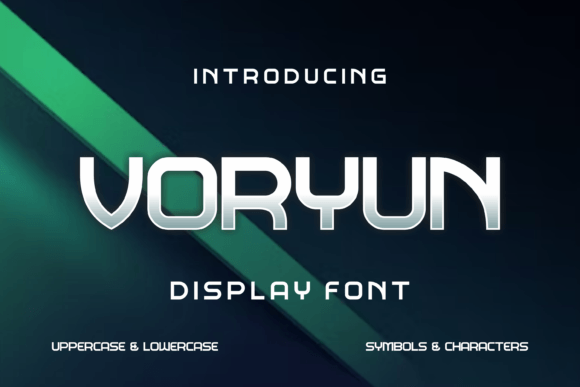
Voryun: A Display Font That Elevates Digital Branding
Two weeks ago, I was finalizing the hero section of a new landing page for a ceramicist’s online studio—a quiet, tactile brand built on hand-thrown forms and earthy minimalism. The headline needed presence, not noise. Not another overused geometric sans. Something that felt intentional, human, and quietly confident. That’s when I opened Voryun.
Voryun is a display font with unmistakable character—clean yet expressive, structured but never rigid. Its letterforms balance subtle contrast with generous open counters, giving it breathing room at large sizes without sacrificing visual warmth. It’s not a script, not a serif, not a monoline sans—it occupies its own thoughtful space: modern enough for a digital product launch, refined enough for an artisanal brand kit, and distinctive enough to anchor a full-page banner without overwhelming.
I dropped “Handcrafted Ceramics” into the hero heading using Voryun Regular, set at 4.5rem on desktop and 2.75rem on mobile. Instantly, the layout felt more resolved—not just prettier, but *clearer*. The font’s generous x-height and carefully tuned spacing improved scannability, especially against the soft-textured background image. No kerning tweaks were needed. No awkward line breaks. Just immediate visual hierarchy.
That’s where Voryun shines most: in high-impact, low-volume contexts. Think hero titles, section headers, course module labels, CTA banners, or logo lockups (when used as part of a wordmark). It’s not designed for body copy—and shouldn’t be. But as a display font, it delivers exactly what modern web design demands: strong first impressions, consistent tone, and effortless readability at scale.
In practice, I’ve used Voryun across several real projects:
- A coaching website’s “Start Your Journey” headline—paired with Inter for all body text and captions. The contrast reinforced trust: Voryun brought warmth and authority; Inter kept everything grounded and legible.
- A boutique online store’s seasonal campaign banner (“Spring Edit”). Set over a muted linen texture, Voryun’s soft terminals and balanced weight created gentle emphasis—no bold needed.
- A portfolio homepage’s project title cards. At 2.25rem on tablet, it remained crisp and inviting, even with light tracking applied for extra airiness.
Readability stays strong across devices—but only when used intentionally. On mobile, I keep Voryun above 2rem and avoid tight line heights (< 1.2). Over dark backgrounds, its medium weight reads cleanly without washing out. Over imagery, I add a subtle semi-transparent overlay or use letter-spacing + text shadow sparingly—not as decoration, but as functional contrast. It’s not a “set and forget” font, but it doesn’t demand constant adjustment either.
Voryun includes one well-crafted weight (Regular) with true italics and standard OpenType features—ligatures, stylistic alternates, and multilingual support covering Latin, Greek, and Cyrillic. That matters. I once swapped fonts mid-project because a client needed French accents in their testimonial carousel—and the fallback broke alignment. With Voryun, those characters render cleanly, preserving spacing and rhythm. No surprises.
For pairing, I default to neutral, highly legible sans serifs: Inter, Manrope, or even system stacks like -apple-system, BlinkMacSystemFont. They’re predictable, fast-loading, and provide perfect counterbalance. If the brand leans editorial—say, a literary newsletter or creative writing course—I’ll test Voryun with a warm, low-contrast serif like Cormorant Garamond for subheads, keeping body copy in a clean sans. The key is contrast without conflict: one voice for impact, another for endurance.
It’s also worth noting: Voryun is a commercial font. I always verify licensing before adding it to client sites, SaaS dashboards, or downloadable brand kits. Most webfont services include clear usage terms—just double-check if you’re embedding in email templates, PDFs, or native apps. And yes, it’s available in WOFF2 format, so load times stay lean—even with custom font-display strategies.
What surprised me most wasn’t how beautiful Voryun looked—but how much *easier* certain decisions became. Choosing a header font used to mean cycling through dozens of options, checking spacing, testing fallbacks, adjusting line height three times. With Voryun, the decision landed faster. Not because it’s “perfect,” but because it’s *cohesive*: every letter feels like part of the same thoughtful system. That consistency translates directly to perceived professionalism—and indirectly, to user confidence.
On a recent blog redesign, I used Voryun only for post titles and category headers. Everything else stayed in a system sans. The result? Readers told us the site “felt more intentional”—not flashier, but more considered. That’s the power of a strong display font used with restraint: it doesn’t shout. It clarifies.
Voryun works best when treated like a design asset—not just typography, but part of your visual language. Use it where users pause, not skim. Where tone matters more than speed. Where your brand’s personality needs to land in under two seconds. It won’t fix weak content or poor layout—but paired with smart spacing, intentional color, and purposeful hierarchy, it helps turn competent digital experiences into memorable ones.
If you’re choosing a display font for your next project, ask yourself: Does it support the message—or distract from it? Does it feel like part of the brand, or just an ornament? With Voryun, the answer is rarely “just.” It’s a tool that invites clarity, rewards intention, and quietly lifts the whole experience—without ever asking for attention.